Can A 1 ½" Barrel Be Accurate?
Insider
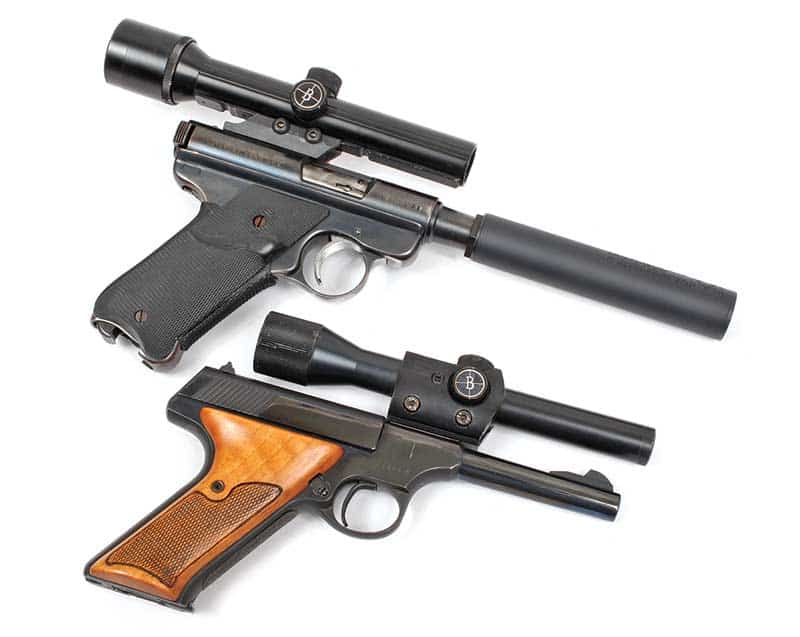
And old Colt Woodsman Roy had put an identical Bushnell Phantom
scope on in the late 1980s was perfect to showcase accuracy from a 4" barrel.
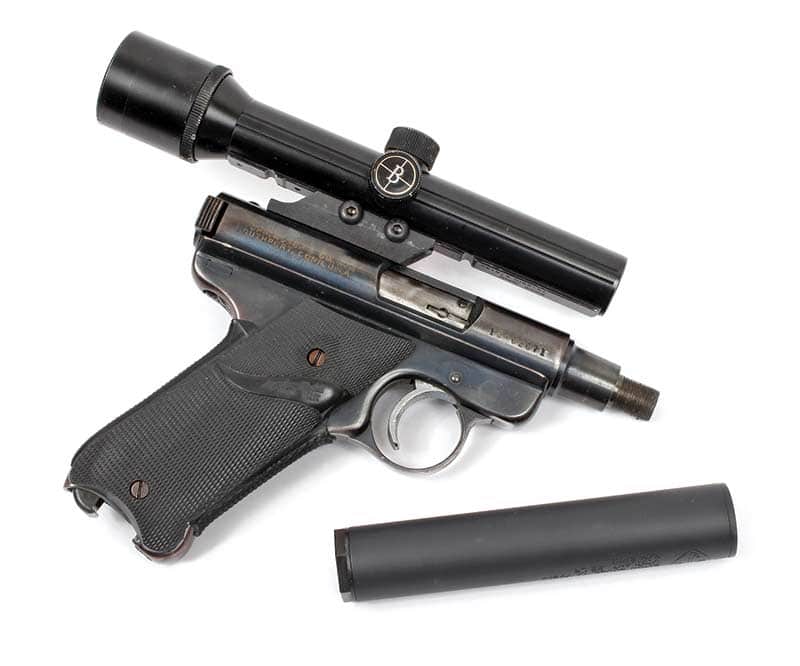
Roy took his circa 1974 Ruger Standard Auto and cut the barrel
back to 1.5", then threaded it for a .22 suppressor. The result
was surprising!
I’ve lost track of the number of people who think short-barreled revolvers and autos are simply not accurate because … “That short barrel won’t allow the bullet to stabilize, so that’s why snubbies are so bad.” Mark Twain said ignorance and confidence are all you need to succeed. Except in this case.
That old wives’ tale is simply not true. The reason longer barrels are “more accurate” is they allow a longer sight radius (the distance between the front and rear sight), and that makes it easier to see mistakes when aiming. With a 6″ barrel, for instance, a few thousandths one way or another will show up in the rear sight picture. Shorten that to 2″ and it’s harder to see that same variable. Unless you take your time and learn to shoot short guns, you will likely think they’re just not accurate.
But they are.
This little test here comes from a request from old friend and writer Jeremy Clough, who you will likely recognize from our pages. Jeremy sent me two Ruger Standard Auto frames to shorten the barrels for an experiment. With the Ruger design, the “upper” holding the barrel and receiver is technically the frame and is serial numbered. The frames began life as 4″ barreled-actions, and Jeremy wanted me to shorten them to 1″ and 1.5″ and thread them for a suppressor. That was unusual and caused me to ponder the thought of what would be the accuracy difference between a 4″ and those shorties. Jeremy was also curious if the short barrels would slow super-sonic .22 ammo to sub-sonic. Interesting ideas to explore, and I was happy to be part of the experiment.
Once I did the work and returned the frames, it dawned on me I had a beater Ruger Standard Auto made around 1974. It had zillions of rounds through it courtesy of my younger brother in years past, and I don’t think it had ever been cleaned. Presto, an idea was formulated. If Jeremy could do it, so could I.

Roy modified a couple of barrels for Jeremy Clough. Here he’s using his lathe to thread one for the 1/2x28 threads needed for a suppressor.
Lathe And Milling Time
If you ever take a Ruger Standard Auto apart, make sure you really understand how to assemble it or it’ll add 10 years to your life. Just sayin’ is all. But once apart, I hacksawed off enough barrel to leave about 1.75″ then chucked it into my lathe. Some turning soon had me at 1.5″ with a 0.498″ diameter section to accommodate threading for a suppressor. Soon, the job was done, and it was time for sights.
I was going to do the red dot thing, but don’t like the fact you can’t wring the best accuracy out with a red dot. Digging through the old scope box, I found an ancient Bushnell Banner and mount, likely for a Thompson Center Contender. It’s an early scope and a bit odd. At 1.3 power, it has the peculiar talent of making things appear smaller when you look through it, but the old-fashioned cross hairs do make precision aiming easier than irons or a dot. I once asked the engineers at Bushnell why it made the image smaller, and they filled my head with “Ancillary optical algorithms subjugating because of errant ocular eye relief issues and ophthalmic collusions can make an image seem smaller when in actuality it isn’t.” Oh, okay, that makes sense now. It’s perfectly clear. Right.
A trip to the milling machine put some holes in the top of the receiver, and the mount went on neatly. I did have to drill out and tap bigger holes in the mount to hold the scope as the old ones were worn, but it was soon up and running. At that point, I had no idea if the gun would even shoot since I forgot to test that beforehand. Some quick test-firing with Mini-Mags and CCI Sub-Sonics with the suppressor attached showed things ran just fine. So far, so good.
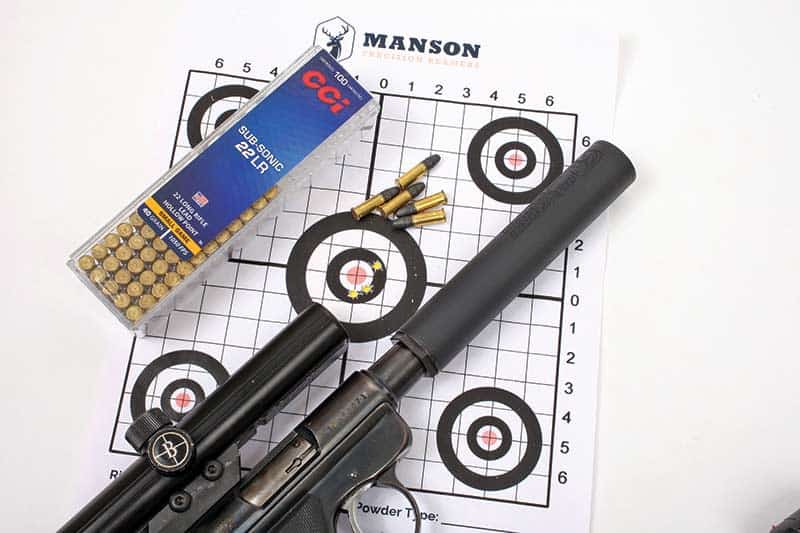
Below: That’s five shots there, into just about 0.75" at 25 yards from the short-barreled Ruger shooting from a bench. In spite of the 1.3 power of the scope, having honest crosshairs really helped doing accuracy testing. The CCI Sub-Sonic shot the best of the CCI ammo tested.
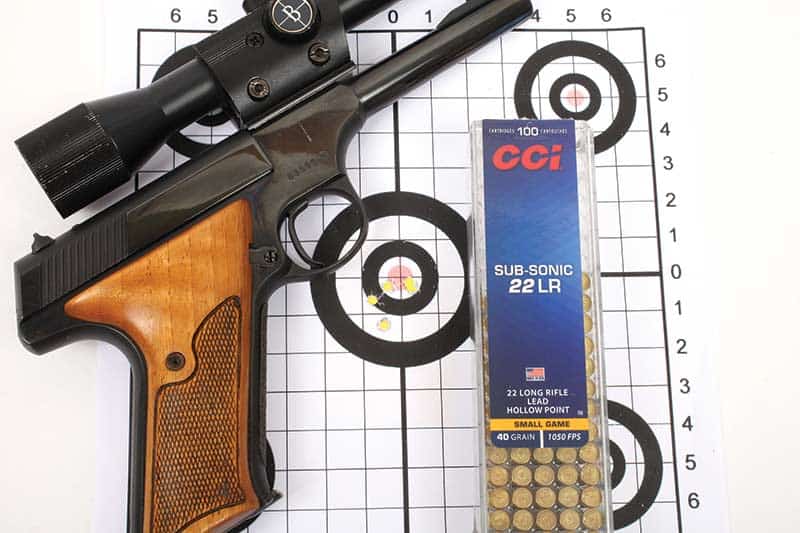
The old Colt delivered a solid 0.85" at 25 yards from a bench.
That’s five shots there and still impressive. Old school is
still good school,
Shooting
Since I lose my mind sometimes, I had forgotten to shoot the gun with the original 4″ barrel, but fortunately, due to my affliction to do odd things, I had an old Colt Woodsman with a 4″ barrel, and I had put a similar scope on around 1985 or so. Seems I liked this idea even back then. So I used it as a stand-in for a 4″ Ruger. Shooting the ammo through both revealed the velocity differences between the 1.5″ and 4″ to be not that much. The CCI Velocitor (1,435 on the box) did 1,063 from the Colt and 931 from the short Ruger.
Mini-Mag HP (1,260 on the box) did 1,033 from the Colt and 924 from the Ruger. The Sub-Sonic (1,050 on the box) zipped at 909 from the Colt and 851 from the Ruger. The suppressor kept things quiet and civilized. The test did show the short barrel slowed down the higher velocity rounds. From a rifle barrel I used, the ammo all clocked at the advertised velocities.
Accuracy was honestly not surprising. From a rest, the 4″ Colt did about 0.85″ at 25 yards using CCI Sub-Sonic loads. The Ruger (with the 1.5″ suppressed barrel) did 0.75″. I like to think that was because of the great crown I put on it! I plan on doing some Ransom Rest testing soon.
So the moral of the story is barrel length doesn’t seem to affect accuracy, but can affect velocity. So there, all you naysayers! I’ve also just discovered my new favoritist anti-squirrel machine.