The Conflagrating Apron That Changed the World
Mankind defines itself by our discoveries. Truth be known, we seldom, if ever, actually invent much of anything de novo. The vast majority of human advancement stems from simply discovering things that God put in place at the very beginning of time. We take stuff from the natural world, tweak and massage it a bit, and then use those processes to make awesome things like Jell-O, Chia Pets, and silicone breast implants.
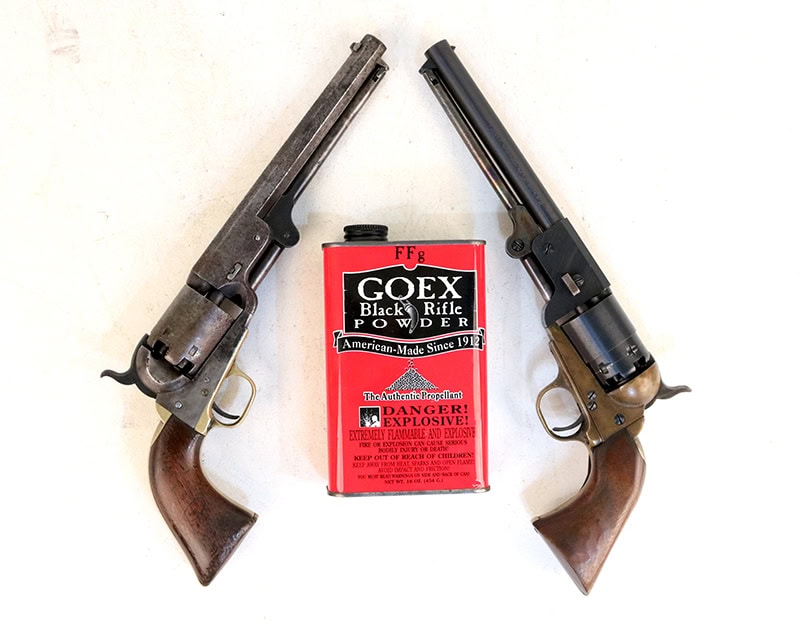
Black powder revolutionized human combat. The 1851 Colt Navy on the left served
during the American Civil War. The example on the right I built from a kit when I was 13.
Better Living Through Chemistry
Of all the many splendored human contrivances, few have had a more seminal effect on world affairs than gunpowder. Black powder is a mystical combination of potassium nitrate, sulfur, and charcoal. Black powder changed the way we killed each other and, in so doing, altered the trajectory of history.
Gunpowder is considered one of the Four Great Inventions of China. Taoists originally concocted the stuff as a form of medicine. Then, in AD 904, somebody thought to cram it into a length of bamboo behind a rock and made the world’s first gun. It’s been onward and upward ever since.
Black powder is indeed energetic stuff. It is considered a low explosive or propellant as opposed to the really good stuff like C4 or Semtex. However, when cooped up within a firearm or a cannon, black powder can do some of the most amazing things. The downsides are that black powder makes an astronomical amount of smoke. It is also really, really filthy.
I am smitten with most anything that shoots. That ranges from helicopter-mounted cannon down to the humble cap-and-ball revolver. Per American firearms laws, black powder weapons that do not use fixed ammunition are not considered firearms. That means they can still be shipped freely through the mail. I bought my first when I was 13.
I burned hundreds of rounds through that cheap Italian 1851 Colt Navy replica. Over time I came to appreciate that an integral part of the shooting experience was the obligatory cleanup afterward. That necessitated a detailed stripping followed by a thorough scrubbing with hot, soapy water. Failure to do so would eventually ruin the gun due to fouling and corrosion.
In combat, this meant that weapons under hard use could become so fouled as to become non-functional. All of that aforementioned white, billowy smoke often completely obscured Civil War-era battlefields as well. There had to be a better way.

Smokeless powder represented a quantum advance in ballistic technology.
The Guy
Christian Friedrich Schönbein was born in 1799 in Metzingen, south of Stuttgart, Germany. He took an apprenticeship with a chemical and pharmaceutical firm at age 13 and found he had a knack for the work. Despite being essentially self-taught, he eventually earned a full professorship in chemistry at the University of Basel in 1828. He served in this place and in this capacity until his death in 1868.
Schönbein was the father of the modern fuel cell. A fuel cell is an electrochemical device that converts chemical energy in a fuel, most commonly hydrogen, into electricity via two distinct redox reactions. Unlike batteries, fuel cells require a steady source of fuel.
Christian Schönbein published his first scholarly article on fuel cells in 1839 in “Philosophical Magazine.” It is hoped that hydrogen fuel cells will eventually replace conventional internal combustion engines powered by petroleum. While that is an undeniably big deal, it was actually a surprise discovery of Schönbein’s that more acutely changed the world.

Christian Schönbein.
Serendipity
Like most such geniuses, Christian Schönbein struggled to leave his work at work. This curious affliction strained the young man’s marriage. His wife had specifically forbidden him from conducting chemistry experiments in her kitchen. Though I have never invented a fuel cell myself, my bride has castigated me for doing dangerous things in her space. In that way, at least, Christian Schönbein and I are similar.
In Schönbein’s case, he was working on some experiment or other in the family kitchen while his wife was away. This task required him to mix nitric acid with sulfuric acid. In his enthusiasm, the 45-year-old chemist spilled the concoction all over the kitchen floor. In desperation, he grabbed his wife’s cotton apron and used it to mop up the mess.
This highly concentrated acidic cocktail did not do the apron any favors. While he tidied up the spill and no doubt crafted some plausible story to justify the chaos, he hung the wet apron up on a nearby peg near the stove to dry. Much to his surprise, his wife’s apron veritably exploded when exposed to heat. Christian Schönbein had just discovered guncotton.
The combination of the cellulose in the apron with the nitro groups in the spilled acid created a fulminant new compound that immediately and utterly oxidized when exposed to heat. The apron was completely consumed. Schönbein saw the potential for this stuff to replace the black powder of the day.
Schönbein sold his invention to an English businessman. However, the first effort at mass production resulted in a spontaneous conflagration that claimed the lives of twenty workers. It did, however, inspire Alfred Nobel to use the same principles to develop dynamite.
Guncotton was and is incredibly unstable. The first few factories built to produce it at scale gained a sordid reputation for spontaneously exploding. However, in 1884 Paul Vielle used Schönbein’s discovery to create something called Poudre B, an early smokeless propellant. In 1891, James Dewar and Frederick Augustus further refined gelatinized guncotton into cordite, named for its ability to be extruded into long, thin, spaghetti-like strands before drying. With time, this all evolved into the nitrocellulose smokeless powder that now drives every cartridge-firing firearm on Earth.

Do you like to shoot? Yeah, me, too. All modern firearms utilize Christian Schönbein’s 19th-century concept.
Ruminations
Christian Schönbein legitimately changed the world. In addition to the fuel cell and guncotton, he also discovered ozone and coined the term. The word ozone comes from the Greek word “ozein,” which means “to smell.” He observed that this odor was similar to that produced by the slow oxidation of white phosphorus. It is also produced by vigorous electrical sparks. In 1990, an asteroid was named after Christian Schönbein. Not bad for a guy who inadvertently incinerated his wife’s kitchen apron.
Get More Guncrank Stories Every Week!
By submitting this form, you are consenting to receive marketing emails from: . You can revoke your consent to receive emails at any time by using the SafeUnsubscribe® link, found at the bottom of every email. Emails are serviced by Constant Contact