The Repurposed War Bear
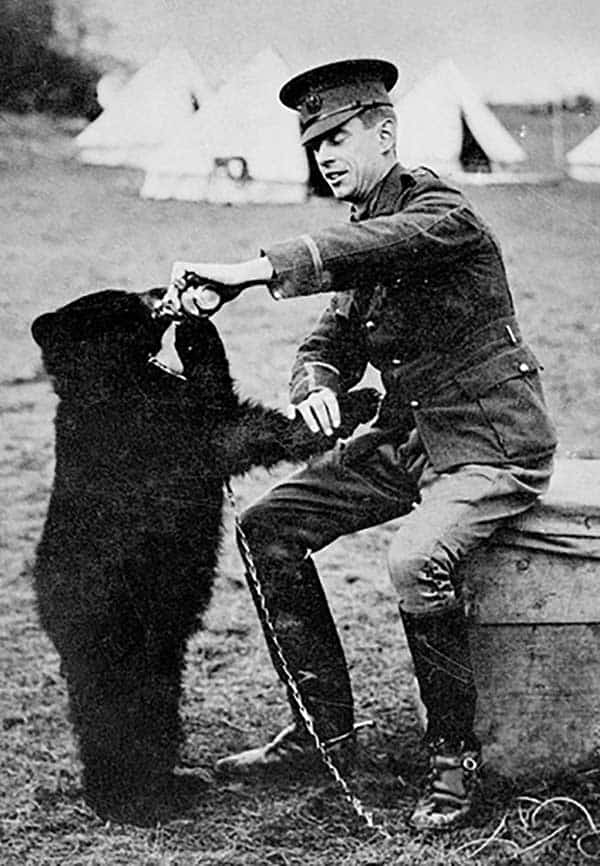
Harry Coleburn purchased Winnipeg the bear from a hunter at a train stop in rural Canada while heading east to go to war.
War is the most horrible of human pursuits. It is worse than murder, divorce, or greed. It takes a nation’s young people — their most precious, useful, productive commodity — and then squanders them for some cause or other. War is the very embodiment of waste.
Tragically, war is also a necessity. Ours is a broken species. There is a darkness in the human heart that must be confronted lest the entire planet descend into anarchy and chaos. However, doing so is innately terrifying.
Young men have gone off to war since the very dawn of time. They band together with like-minded mates and form such extraordinary, portable tribes. These tribes embody great power. However, there is a spiritual component to this curious tribalism. This neo-pagan spirituality often manifests in the form of strange talismans.
The Soldier
In the summer of 1914, the entire planet was getting energized for combat. Troops were mustered from Britain’s colonial holdings around the globe and shipped to Europe to face down the Bosch. As part of the Commonwealth, Canada did its part.
Most of a 1914-era army’s mobility still came from horses. As a result, cavalry units came equipped with organic veterinary support. One of those Canadian military veterinarians was a man named Harry Coleburn.
Coleburn was born in Birmingham, England, before hopping across the pond to attend veterinary school in Toronto. After earning his degree in veterinary surgery in 1911, Coleburn moved to Winnipeg, Manitoba. With war clouds looming, Harry Coleburn offered his services to the armed forces. He was assigned to the Fort Garry Horse, a militia cavalry regiment. In short order, Coleburn found himself on a troop train heading east toward the fire.
The Bear
Coleburn’s train stopped at Valcartier, Quebec, to embark passengers. Coleburn availed himself of the opportunity to stretch his legs. While wandering about the station, the Army vet encountered a Canadian hunter with a curious parcel. The hunter had recently killed a bear only to discover that she had a female cub. The hunter had slipped the terrified little bear into a sack and happened to be passing by. On a whim, the homesick vet offered the man $20 for the creature. That would be about $530 today. Coleburn clearly loved animals, and he felt the snuggly little rascal might be good company.
Young men seldom actually think. That’s why 19-year-olds make the best soldiers. They will do stupid, insane, impulsive things for some of the most curious reasons. Harry Coleburn did not need a bear. Everything about that decision was wrong. However, he did it anyway and on impulse. When his commander found out about the purchase, he lent his support. His men would be lonely and afraid. Having an American black bear as a mascot might be a welcome diversion. Coleburn named his little bear Winnipeg after his hometown.

Winnipeg became the unit mascot and a beloved member of the tribe.
The Bear Goes To War
Personally, I’m afraid of bears. When I was stationed in the Alaskan interior, I saw fish-fed brown bears that were as big as Volkswagens. I felt these massive creatures were best appreciated from about 2,000 feet in an Army helicopter. However, Winnipeg was a social bear. She had never known anything but humans. Hers was a gentle and playful demeanor. The Canadian troops preparing for war adored her.
Once in England in October of 1914, Winnipeg and Coleburn were assigned to the headquarters of the Second Canadian Infantry Brigade. These Canadians then reported to the Salisbury Plain for training prior to deployment across the Channel to the war zones. Two months later, it was time.
Coleburn and his Canadians loved their pet bear, but they had sense enough to appreciate that the fetid trenches of France would not do her any favors. With regret, Harry Coleburn made a quick trip into London, leaving his beloved bear with the keepers at the London Zoo on 9 December 1914. He then deployed to mainland Europe.
Harry Coleburn survived the war, demobilizing as a Major. On his way back through England heading home, he dropped in to check on Winnipeg, intending to take her back to Canada. However, when he found out how popular the playful, socialized bruin was with local children, he formally donated her to the zoo. There, she remained for the rest of her natural life.
The Rest Of The Story
Among Winnipeg’s many fans was the son of one Alan Alexander Milne, a writer of some renown. The young man’s name was Christopher Robin Milne, and he had a stuffed bear of his own named Edward. Smitten with Winnipeg’s antics, young Christopher Robin formally changed the name of his own toy bear to Winnipeg. Over time, he shortened that to Winnie. Christopher Robin’s subsequent adventures with his dearest friend, Winnie-the-Pooh, have delighted children by the millions.
Get more Guncrank free every Friday. Subscribe here: AmericanHandgunner.com/guncrank/