How Not to Get Banned From the Gun Store
Basic Gun Store Etiquette
There is no safe direction in the middle of a crowded gun store.
The floor is often concrete, which does not make the ideal “safe backstop.” The wall may have a stockroom, office or employee on the other side. The ceiling may lead to someone’s office upstairs or perhaps open sky after the thin leased-space roof is perforated. And, of course, the customer browsing some other area of the counter has no desire to see your muzzle.
Gun-counter etiquette sounds like a beginner topic right up until someone sweeps three customers and dry-fires at something they’re not really willing to destroy. Then it becomes all of our business.
And we’ve all seen the videos of a live round somehow going off in a gun store, even though live cartridges are not supposed to be native to that environment. It’s the unwritten part of the four rules of gun safety. Somehow or another, live rounds have a way of making their way into places they’re not supposed to be. Where else does the oft-heard line, “I thought it was unloaded…” come from?
The good news is that safely shopping for a handgun requires no secret handshake, fishing vest or encyclopedic knowledge of obscure European cartridges. It takes four basic safety habits, a little communication and a willingness to ask before doing something.
Etiquette is a bit different from hard-and-fast safety rules, but they often overlap. Let’s take a look at gun store etiquette as it relates to, you guessed it, gun store safety.
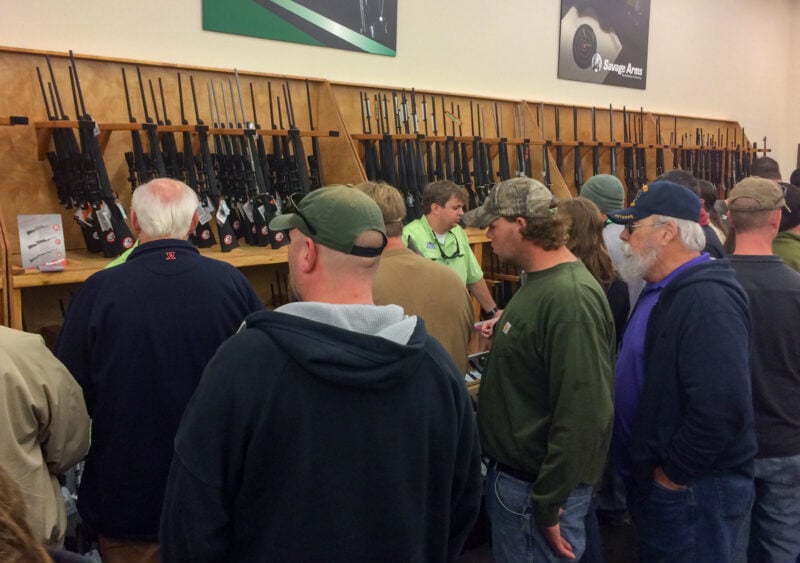
While rarely this busy, stores always have other people around,
making the safety challenge even tougher for all involved.
Let the Clerk Start the Dance
When the clerk hands you a pistol, watch how they clear it. Then clear it yourself. Of course, we’re assuming the clerk knows and uses some reasonable variation of standard practice, checking the magazine (or cylinders) and chamber carefully.
That second check isn’t an insult. It’s what careful gun handlers do. Most staff will appreciate the attention to safety and the courtesy of showing them you care about keeping them unperforated. If they give you an eye roll because they obviously just checked, find someone else to help you.
Remove the magazine if it’s still present, lock the slide open and look into both the chamber and magazine well. Stick a finger in there while you’re at it because those areas can be dark and hard to see. On a revolver, open the cylinder and inspect every chamber. If you don’t know how a particular action works, say so. “Can you show me how to clear this one?” may be the most reassuring sentence a clerk hears all day.
Here’s the etiquette-overlaps-with-safety part: Ask the question too many people skip: “Where would you like me to point it?”
Often, stores establish a designated safe direction, sometimes with a purpose-built clearing barrel or backstop. Use whatever direction the staff identifies. Don’t improvise based on which wall looks the thickest.
From that point on, keep the muzzle in that direction unless the clerk directs otherwise. And keep your trigger finger straight along the frame. It can be a busy place, and we’ve already established there’s often not a completely safe direction in a store, so extra caution never hurts.
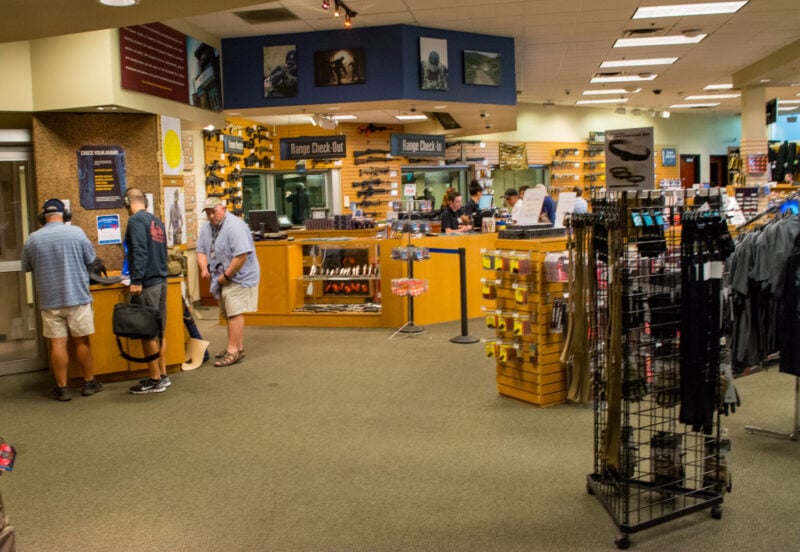
Many stores have range facilities on the premises. That's a lot more potentially loaded guns coming and going.
The Trigger Is Not a Fidget Toy
A trigger matters when choosing a handgun. Fit and reach for your hand size, pull weight, take-up, break and reset are all attributes you’ll probably want to know before spending your hard-earned money. So, yes, ideally you’ll want to dry fire in the store.
Here’s another etiquette and safety overlap: ask permission first.
Some guns shouldn’t be dry-fired without snap caps. Even if you know a particular model is fine to dry-fire without caps, the store may believe otherwise. Some stores prohibit dry-firing for safety reasons. Others allow it only in a particular direction. The store owns the gun and is responsible for everything that happens inside, so this isn’t the moment to assert your rights under the “Customer Is Always Right” argument, even if you are in fact right.
If the store if OK with some trigger testing, clear the gun again before messing with the trigger. Remove the magazine, open the action and visually inspect the chamber and magazine well. Don’t merely rack the slide and assume an unseen extractor did its job. Look.
Then point in the designated direction and do your trigger examination.
I know this sounds redundant, and you’re right. It is. And with good reason.
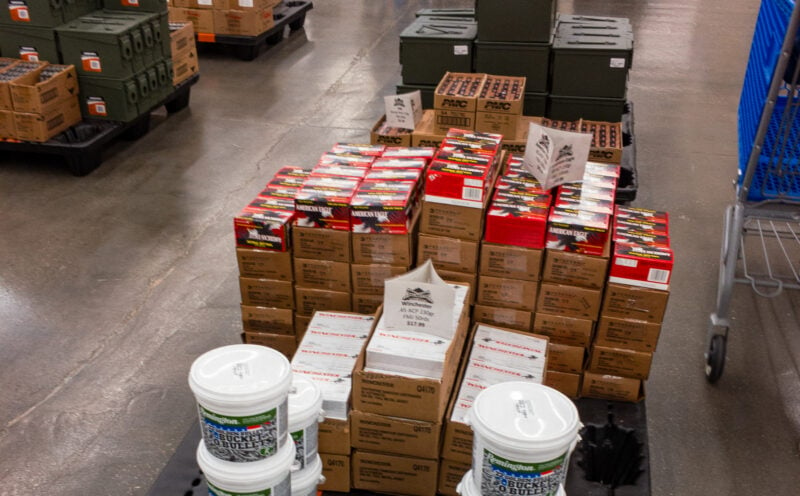
In theory, keeping guns and ammo separated is great, but hard to do in a gun store as they're full of both.
In a 2020 incident captured on store surveillance video, a customer stood at a busy counter with a GLOCK, produced a loaded magazine and was reportedly told by an employee not to insert it. He put it away, pulled it out again seconds later, inserted it, moved among other customers and released the slide. The pistol fired into the floor. No one was hurt, which had more to do with luck than technique. The store reportedly banned him for life. They should have beaten him to a pulp.
The failure wasn’t a lack of experience with the gun’s controls. The guy appeared quite comfortable manipulating it, even if careless. The failure was treating familiar motions as harmless while ignoring the muzzle, trigger and direct instruction from the staff. Confidence without attention is just a faster route to doing something stupid.
As a side note, here’s one of many possible examples of how real cartridges can make their way into an “unloaded gun” environment. In a different version of this scenario, the customer may have inserted his magazine and at some point simply racked the slide. Then later, removed his magazine and gone on his merry way. Now an “unloaded gun” in the counter has a live cartridge in it. Similar things happen far too often with guns brought in for consignment sales or repairs.
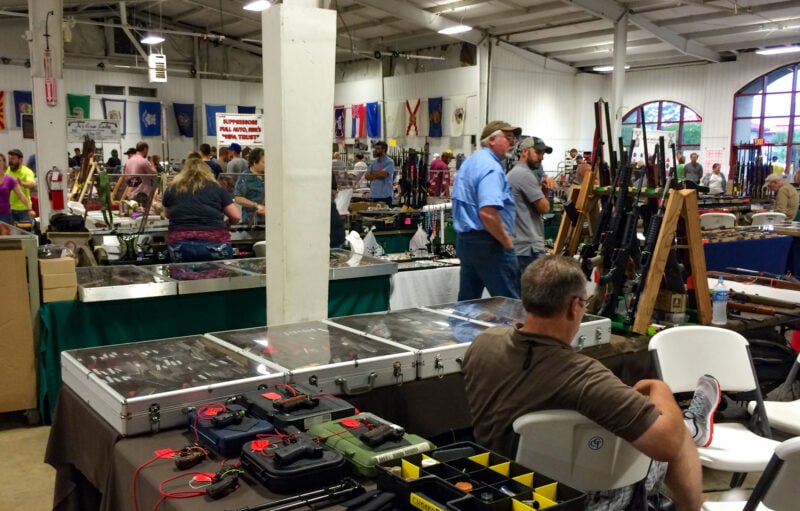
If gun stores rarely have a "safe direction" consider a gun show.
Concrete floors, lots of people, and thin walls and ceilings.
Your Gun Deserves the Same Treatment
Another ugly incident near Boardman, Ohio, began when a customer brought his own handgun into Fin, Feather and Fur Outfitters while shopping for a holster. According to a police report, the customer became argumentative when asked whether the gun had been checked at the service desk, saying he wasn’t stupid enough to bring a loaded gun into a store. Anyway, an employee removed it from its case, cycled the slide twice, pointed it down and left. Then, and you guessed it, the gun fired, shattered a glass display case and injured another employee’s arm.
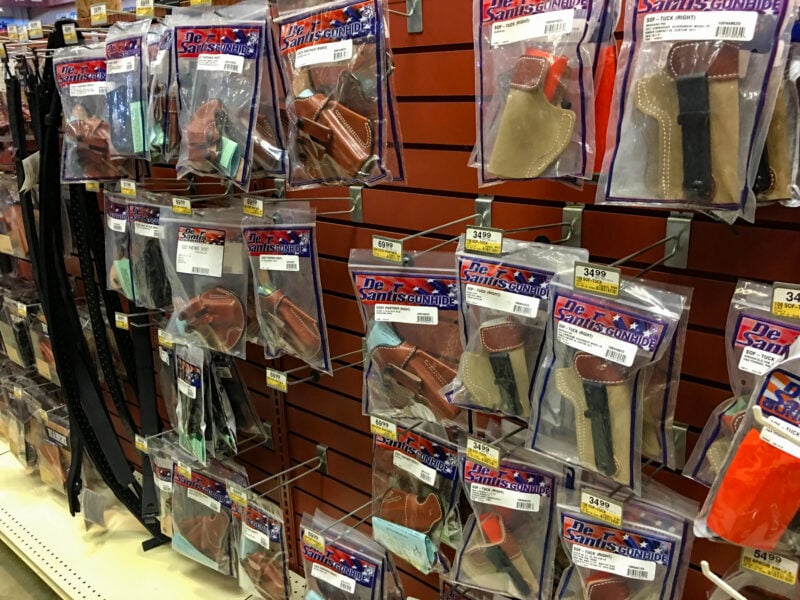
Gun stores are convenient for a "hands on" look at holster options,
but don't bring your loaded gun in for trial, like one guy did.
There’s plenty of failure to share in this one. A loaded gun entered the store despite posted rules requiring firearms to be empty and rendered safe. Yes, the guy claiming he wasn’t stupid was, in fact, stupid. Not necessarily for the gun being loaded as much as his arrogance in not re-checking or allowing someone else to double-check. Pride comes before the fall, as they say. The employee who accepted the gun apparently failed to remove the magazine, lock the slide open and verify the chamber before further handling. Someone wound up in the hospital because of a chain of failures.
Instead of getting aggravated at a store’s seemingly redundant policies, be happy they care so much about safety. None of us should ever be insulted by another person following up on something we’ve already checked. If you bring a gun into a shop for a holster, sight installation, trade or repair, follow the store’s policy before entering. Unload it at home, case it and keep the action open if the design and case allow. Use a chamber flag when practical. Keep ammunition away. At the store, tell the staff exactly what you brought and let them direct the handoff.
“But I know it’s unloaded” is not helpful. Every gun involved in a negligent discharge was “unloaded” in someone’s mind moments earlier.
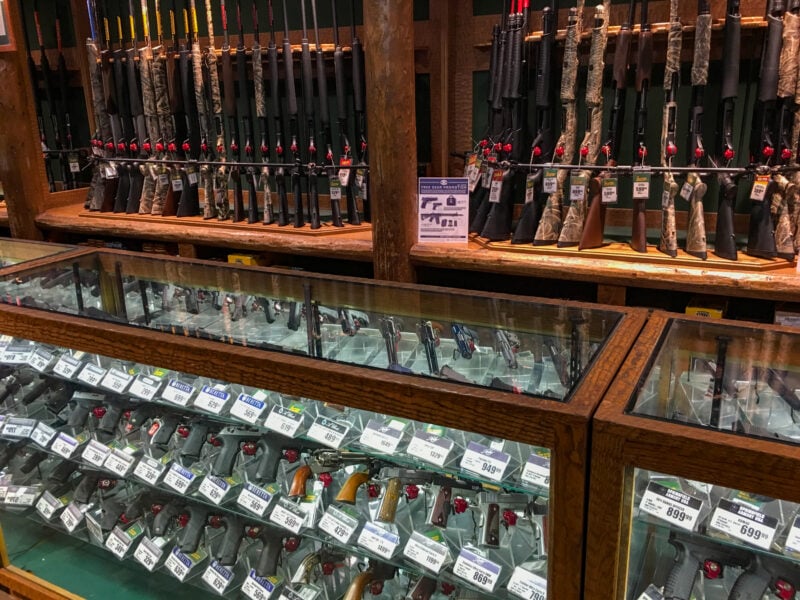
It may sound seem likely, but there are plenty of ways a live round (or more)
can make it into one of the many guns on display.
Losing Pride
I get it. If you’re reading this, you’re likely more knowledgeable than many gun owners and casual shoppers. Sometimes, we’re more knowledgeable than a staff member at a gun store.
But that doesn’t excuse any of us from not just playing by the established rules, but thinking about the etiquette angle as well. Showing your commitment to safety by double-checking and asking before doing is not just a sign of respect, but a signal to the person helping you that you care about safety as much or more than they do.
Welcoming the double checks built into the system is the only way to end those negligent discharges caused by “unloaded guns” just “going off.”
Get more exclusive online content from American Handgunner delivered straight to your inbox. Sign up for our free American Handgunner Insider newsletter.