Crimping: The Most Misunderstood Step in Reloading
The Ultimate Reloading Series Part 9

You have to look carefully, but these cartridges all use a roll crimp.
As you can see, it doesn't take a lot of reshaping to do the job right.
If there’s one reloading step that confuses new handloaders more than any other, it’s crimping. The word itself is part of the problem. “Crimping” sounds like you’re mashing brass against a bullet to lock it in place. That’s not what’s happening, and treating it that way will cause you grief. Of course, there’s a partial exception, and that’s where much of the confusion lies. Hold this thought.
What Crimping Actually Does
For most semi-auto pistol cartridges, crimping is nothing more than removing the flare you put on the case mouth during the belling step. That’s it.
You opened the mouth to let the bullet get started, and now you’re closing it back up so the case walls are straight and parallel again. This is called a taper crimp, and for calibers like 9mm, .40 S&W, and .45 ACP, it’s the only type you should be using.
Roll crimping is a different animal. With revolver cartridges like .357 Magnum and .44 Magnum, the case mouth is actually turned inward into a groove on the bullet called a cannelure. This creates a mechanical lock that helps keep the bullet from shifting under heavy recoil. When a magnum revolver goes off, the remaining rounds in the cylinder experience serious G-forces, and without a solid roll crimp, bullets can start creeping out of their cases or get shoved deeper in.

A good view of proper taper crimps for straight-wall cartridges. These 9mm cartridges headspace on the case mouth.
The Big Misconception
Here’s the part that trips people up. Crimping is not what holds a bullet in the case. Case neck tension does that work, and the two are not the same thing.
Think of it like drilling holes in a 2×4 and inserting wooden dowels. If you drill a hole slightly smaller than the dowel, you’ll have to force it in. Once it’s there, friction between the dowel and the walls of the hole holds it tight. That’s case neck tension in a nutshell. With cartridge cases, the resized brass is slightly smaller than the bullet, creating friction along the entire contact surface.
Now imagine drilling an oversized hole and trying to fix the loose fit by clamping the board in a vise. You can squeeze the sides all day long, but you’ll never recreate the grip you’d get from a properly sized hole. Crimping a loose bullet works the same way. If your case neck tension is wrong, no amount of crimping will fix it. You might actually make things worse.
Get your sizing and belling right, and the bullet will seat firmly on its own. The crimp is just the finishing touch, not the structural support.

Note the aggressive crimps on these, especially on the .308 cartridge in the center.
Why Headspace Matters Here
To understand why you use one type of crimp over another, you need a quick detour into headspace. In simple terms, headspace is the cartridge’s front-to-back position in the chamber. Something about each cartridge’s design determines where it stops when it’s loaded.
Straight-wall pistol rounds like 9mm and .45 ACP usually headspace on the case mouth. The front edge of the case butts up against a ledge in the chamber, and that’s what positions it correctly. This is exactly why these calibers require a taper crimp. If you roll crimp a 9mm case, you eliminate that hard edge, and the cartridge can float back and forth. Too much free play means the firing pin might not strike the primer hard enough, or worse, the case can stretch when fired and vent hot gas rearward.
Rimmed revolver cartridges like .38 Special headspace on the rim, not the mouth. Since the case mouth isn’t doing positioning duty, you’re free to roll crimp without affecting how the round sits in the chamber.
Bottleneck rifle cartridges often headspace on the shoulder of the case, so the mouth is available for either type of crimp when appropriate.
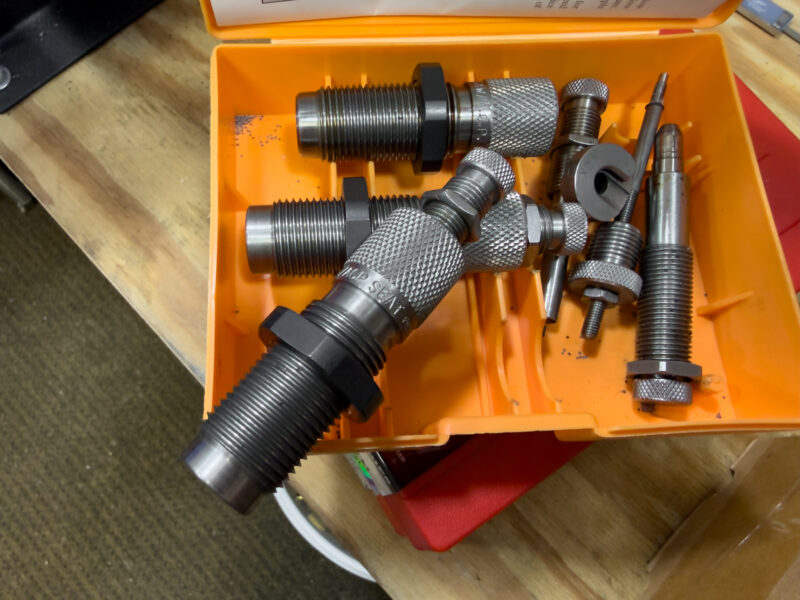
Most 3-Die pistol-caliber dies sets using a combination seating and crimping die.
You can set it to do both steps, but I prefer to separate the two operations. Just raise
or remove the seating plug depending on the die design.
Taper Crimping in Practice
If you followed my advice in the seating chapter and kept seating and crimping as separate steps, this part is easy. Remove the seating stem from your die so it’s out of the equation. Insert a cartridge with a seated bullet, raise the press ram, and screw the die body down until it contacts the case mouth. Your die instructions will tell you how much further to go, but it’s usually about a quarter turn beyond first contact.
The number one mistake here is overdoing it. All you need is enough crimp to remove the bell from the case mouth. A proper taper crimp should leave the case walls straight and parallel. Crank it too far, and you risk accuracy problems, feeding issues, and bullets that behave unpredictably downrange. More is definitely not better.
Check your work with calipers. Your reloading manual will list the correct case mouth diameter for the caliber you’re loading.

Lee makes a wide variety of dedicated factory crimp dies. The "plug" on this one simply secures
the removable taper crimp sleeve inside. It's not for adjustment. Moving the whole die accomplishes that.
Roll Crimping in Practice
The mechanical process is identical to taper crimping. The difference is in how far you go and what happens to the brass. Instead of just straightening the case walls, you’re driving the mouth into the cannelure groove on the bullet.
With heavy recoiling revolvers, don’t be shy about applying a firm roll crimp. Magnum loads demand it. Your die manufacturer’s instructions will guide you on how much adjustment to apply, and within reason, more crimp is better than less when you’re dealing with the kind of forces a .44 Magnum generates.

I love .357 SIG because it's weird. While a pistol caliber, it uses two-die sets like rifle cartridges.
You can get dedicated crimp dies or separate the seating and crimping operations by adjusting
the combination die (left.)
What About Rifle Cartridges?
Bottleneck rifle cases don’t go through a separate belling step. The resizing die expands the case neck evenly when it sizes the exterior, so there’s no flare to remove. In many cases, you can skip crimping entirely.

This Hornady die seat uses a floating crimp and seating insert to auto-center the cartridge as it goes into the die.
The exception is bullets with a cannelure groove. If your projectile has one, you can crimp into it for extra security. Since bottleneck cartridges usually headspace on the shoulder, either taper or roll crimps work fine here. Military-spec ammo in calibers like 5.56mm and 7.62×51 uses aggressive crimps for exactly this reason, keeping bullets locked down under the punishment of automatic fire.
No cannelure? No crimp. Pressing the case mouth into the side of a smooth bullet just deforms things and hurts accuracy. Seat the bullet, adjust per your die instructions, and leave it alone.
If you missed Part 8 (Bullet Seating).
Get more exclusive online content from American Handgunner delivered straight to your inbox. Sign up for our free American Handgunner Insider newsletter.