A Border Has Two Sides
Building the South-of-the-Border 1911
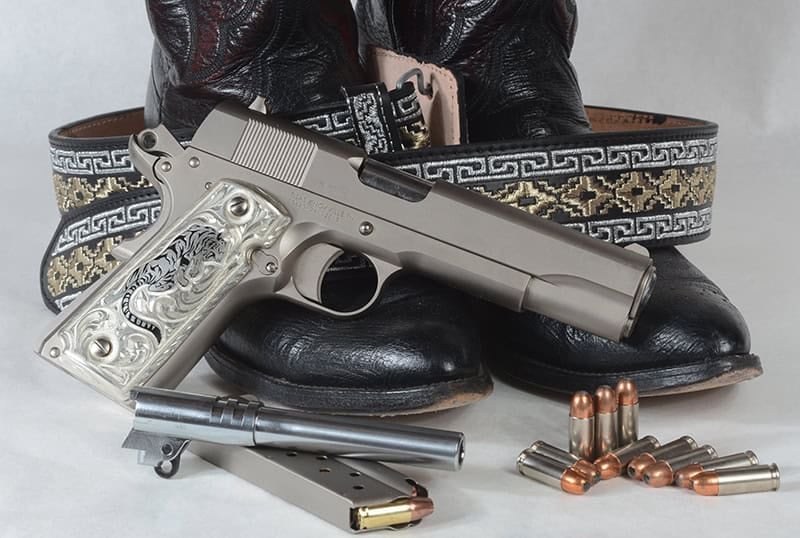
In my study of Western guns from just after the turn of the 20th century, I initially failed
to notice every border has two sides. SDS’s nickel Stakeout fit the bill
perfectly for a Mexican-style 1911, and even comes in the 38 Super that’s the appropriate
caliber for down south. While no longer available from SDS,
a wide range of these models recently hit the market at very attractive prices.
Sometimes our firearms pursuits bring us to a crossroads. One lane, if you will, began with a prompt from industry icon Dick Williams. Formerly of SureFire, Uncle Dick is a Gunsite Senior Fellow and head of his eponymous Irregulars, an invitation-only group of industry professionals that meets twice a year at the famed shooting school. One of these events focused on border guns, which meant the irons with which the fightin’ got done from the late 1800s to the early 1900s. This era saw lawmen saddle up with auto pistols like the 1911 and Luger, and semiauto long guns like the Remington Model 11 shotgun and magazine-fed Model 8 rifle, a spectacular mashup of Old West and the same sort of guns we rely on today. Any who doubt, there’s a wonderful photo of a Texas Ranger on horseback with his SAA and a Thompson submachinegun.
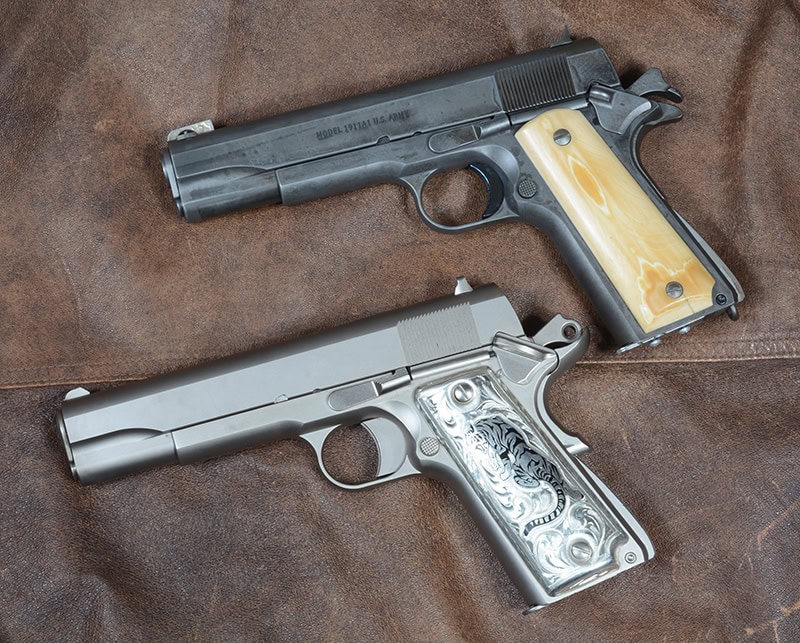
There’s more than one way to Western. Both these SDS 1911’s shoot .38 Super and 9mm:
the top was converted to a Ranger-style pistol, while the bottom needed only
a grip change to resemble guns from south of the border. With a recent change in
importation, a large number of these guns have hit the market.
Each Side Of The Border
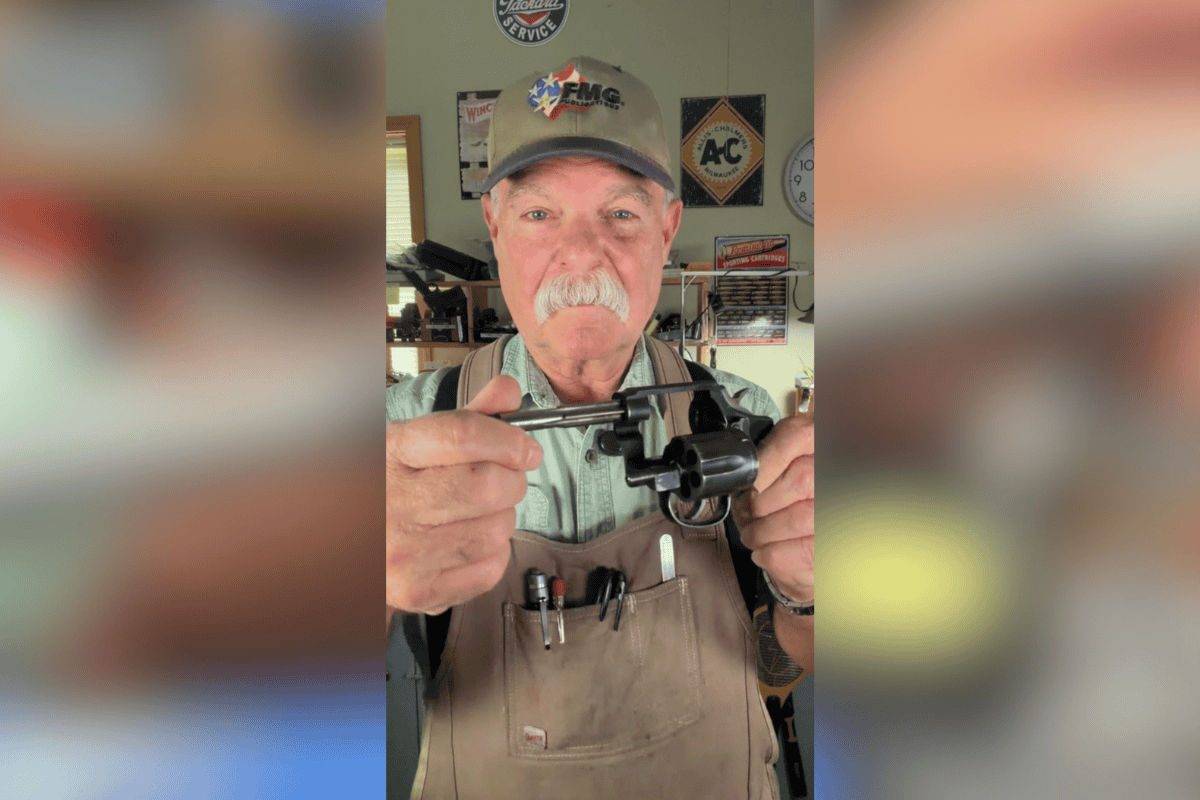
I promptly scared up a Winchester ’92 in .44/40, a Model 12, a spur-hammer pre-A1 Colt 1911, all too pretty to shoot. I already had single actions, so a Smith 1917 — still the high point of fighting revolver design — rounded it out. I then wandered down the rabbit hole of what defined a Western 1911, as typified by Ranger guns of the era, which explains the ivory-stocked SDS pistol I converted to .38 Super for FMG’s DIY a couple years ago.
At the same time, a friend of mine fighting the Mexican drug war wanted to commemorate his service with a custom pistol patterned after the ones he’d seen down south. Appropriately, the project was nicknamed the Narcoleven. And that’s when it occurred to me, mired in my fascination with guns used in Texas and Arizona, that a border has two sides.
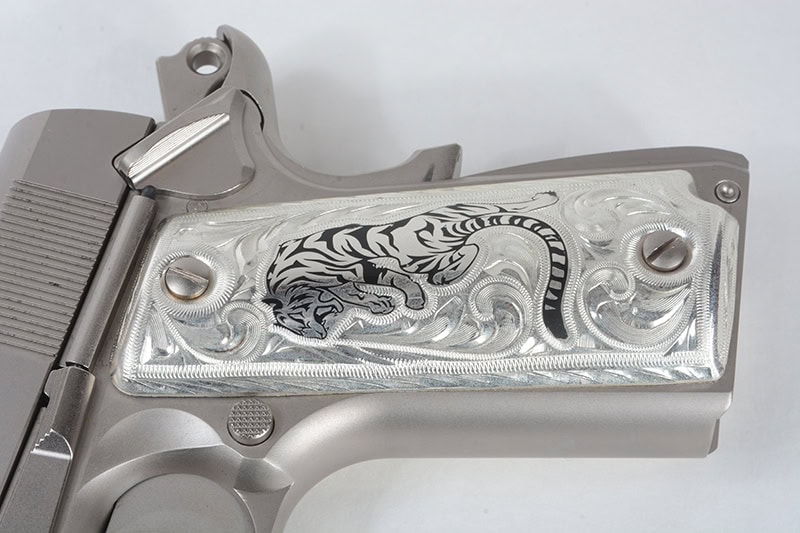
Choose your iconography carefully: lots of the imagery found on flashier grips may have hidden meanings.
This pair of tiger grips is made of nickel silver, which should age with a mild yellowish cast.
Mexican Cowboy Culture
For those of us raised on Gunsmoke and John Wayne, it’s all too easy to forget how strong Mexico’s cowboy culture is and how much it influenced our own. There’s a reason Ruger named its cowboy sixgun the vaquero. Mexican charros rodeo, with a pageantry seldom seen outside of the bullring and a strong gun culture of their own — a culture to which the 1911 is no stranger.
The 1911 is one of only two guns I know of with its own mariachi song (the other is the Winchester 94, if you were wondering). “Bring my .45 with its four magazines,” Francisco Charro Avitia sings in Traigo Mi .45, “and bring fifty bullets.” There’s also an old Colt ad showing a Mexican cowboy astride a rearing horse, 1911 held high, over the words Pistola Automatica Colt Calibre .45 Modelo del Gobierno. Clearly it’s old because it’s been a long time since Mexican citizens could own military calibers like the .45, which explains the popularity down south of the .38 Super. Which appears in a modern narcocorrida or two that we won’t promote here, bringing us to some uncomfortable ground that needs to be covered.

The design of the Stakeout is solidly 1911A1, with a couple variations—including a rowel hammer
and beavertail grip safely that makes the gun a comfortable shooter.
Narco Guns
Narco guns are a thing, and if you’ve followed the Mexican drug war, you’ve doubtless seen gold-plated AK’s, bejeweled 1911s and the various other lethal bling of drug trafficking and its associated death cult of Santa Muerte. They’re not the only ones with guns. While firearms are tightly restricted in Mexico, both organized autodefensas and individual citizens have fought back against the cartels, including Don Alejo Garza Tamez, who battled the bloodthirsty Zetas in one of the great last stands of all time. On that side, also, there is the 1911, often modified, but generally not as gaudily as the narco pistols. With this background, my starting point could only be a .38 Super 1911, preferably with a bright finish — but not too bright. The nickel Stakeout from SDS came immediately to mind.
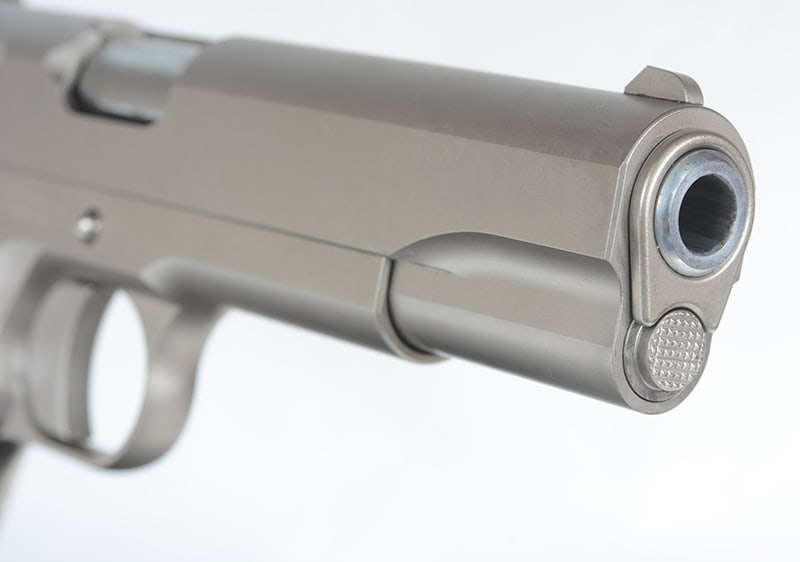
The muzzle end of the Stakeout has been partially beveled, as is always nice on a working gun.
It comes with barrels in .38 Super and 9mm, which appear to be chrome plated.
The Stakeout
I’d first been exposed to SDS 1911s at Gunsite, where a friend handed me one that promptly hit 8/8 on steel at 84 yards, duly impressing both the Rangemaster and me observing the festivities. Sadly, SDS (which imported the guns) and Tisas (which manufactured them) have parted ways, but that has dropped quite a few of those guns on the market at very attractive prices — and the ones I’ve shot have punched well above their weight.
Like my first SDS, the Stakeout came with a tag noting the forged slide and frame and describing how it was machined after hardening, which accelerates tool wear but maintains dimensional stability during manufacturing.
The Stakeout generally follows the classic lines, with the addition of a beavertail grip safety and rounded rowel hammer. Sights are fixed, with serrated sighting surfaces, and the gun is plated with a matte nickel finish that gives off a soft silver glow. The finish also covers the sights, which is the one mechanical thing I’d change: I’ll probably bead blast the sighting surfaces and touch them up with cold blue, since silver-colored sights tend to fade away in the light. The long solid trigger breaks nicely at a bit over five pounds, and the arched mainspring housing gives the gun that familiar A1 feel.
It also comes with a second barrel and magazine in 9mm. This helps because not everyone may love the .38 Super as much as I do, and those who do know it’s not the easiest or cheapest ammo to find. 9mm is, so the dual calibers make for a flexible pistol. Mechanically, the breechface dimensions, extractor and ejector length are different between 9mm and .38, but they can all be adjusted to play nice, and SDS has done a good job of it. Both barrels have integral feed ramps in the Nowlin pattern, but my early pistol does not have the full chamber support of other versions (later guns may be different). This makes for a nicely-feeding pistol, but if you’re looking to handload your .38 deep into .357 Magnum territory, check for full support or start somewhere else. As I expected, the Stakeout shot well. I could make regular hits on the 10×16” ram at 100 yards from the bench, and from standing on a good day.
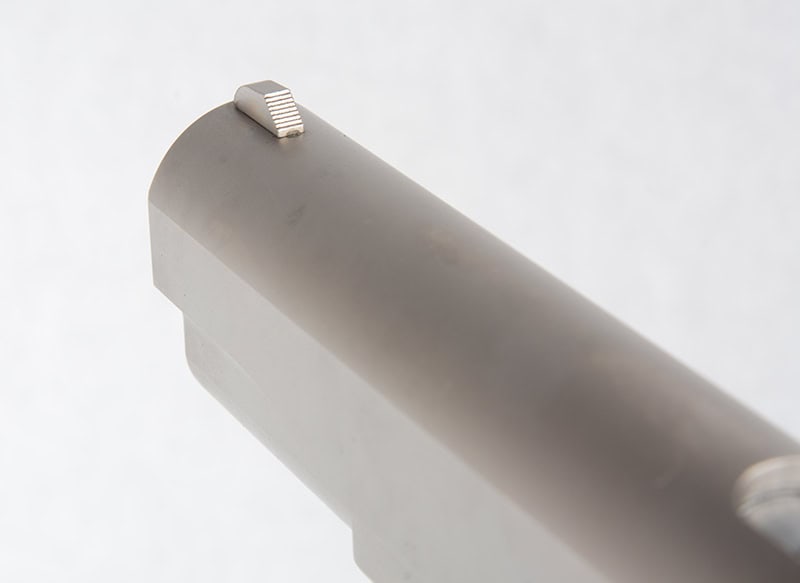
The only mechanical change I’m likely to make on the Stakeout is the front sight: silver tends
to disappear in sunlight, so I’ll likely blast the sighting surface and cold blue it.
Know What The Symbol Means
I’m an inveterate customizer, but the gun needed nothing more than grips to give it the right style. Metal grips have long been a feature of Western pistols, and it’s harder to think of a cooler pistol than a pre-A1 1911 with period Mexican silver grips. Perhaps the only thing harder is actually finding a set, especially one without three zeros in the price. That leaves us looking for modern grips.
A quick internet search for “Mexican silver grips,” or some such, will flood you with options from fairly staid Mexican flags to a rainbow of jewel-encrusted panels, marijuana leaves, skulls, horses, caliber markings and saints. Herein is wisdom required: before you pick a symbol, make sure you know what it means. Obvious, perhaps, but the success of criminal symbols often depends on their subtlety. Inadvertently advertising yourself as a narco at the range can lead to a whole host of problems, including creating a running start on probable cause for any law enforcement officer versed in such things. Worse outcomes lurk.

The Stakeout has eaten everything I’ve fed it in both calibers, and is accurate enough
to make good hits out to 100 yards.
The commonly encountered St. Judas, for example, has an entirely different meaning depending on the hand in which he’s holding his staff. According to a gun-guy Catholic priest friend of mine, the Crucifix and the Virgin Mary are right out, partially on the grounds that he wouldn’t want to explain to Jesus why he stuck His mama on the side of his gun.
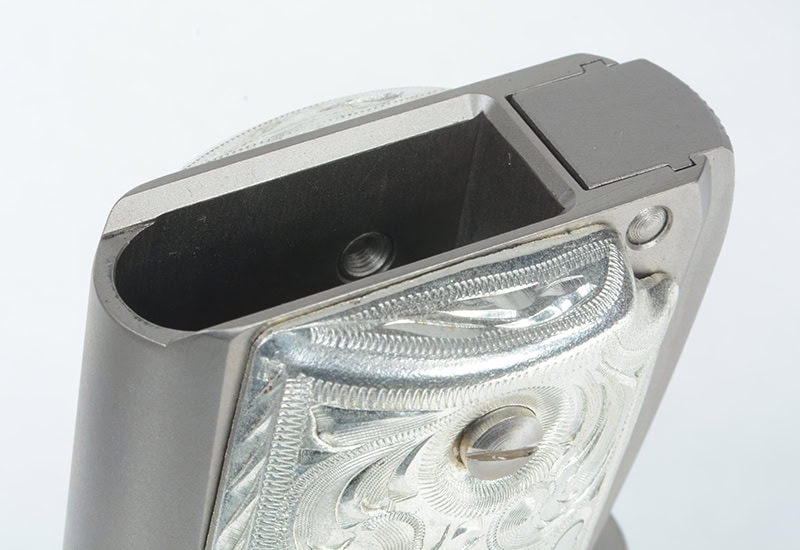
The magazine well is nicely beveled to speed reloads. Note the bevel cuts all the way through
the frontstrap, eliminating the pair of fangs usually left on either side when the cut
curves around the inside radius of the frontstrap. If you’ve ever caught a bit
of hand between those and a floorplate during a fast mag change, you know exactly what I mean.
El Tigre
Animals … animals seem safe. I’ve long had an affinity for the big cats, and wound up with grips engraved on each side with a tiger, leading to the gun’s nickname El Tigre. You won’t mistake the engraving for Colt Custom Shop work — it’s likely rolled or stamped in — but it’s a nice touch, and the nickel silver will age with time to a soft yellow, not entirely different than the pale yellowish cast acquired by nickel as it ages.
… and don’t they all look better with a little wear?
Get More Insider Content Every Week!
By submitting this form, you are consenting to receive marketing emails from: . You can revoke your consent to receive emails at any time by using the SafeUnsubscribe® link, found at the bottom of every email. Emails are serviced by Constant Contact