S&W’s Too-Tough Terrier!

A bit of history in the flesh. A 3rd. Model Safety Hammerless .38 S&W (1896) at top, the vintage 1948 Terrier, also in .38 S&W next and a .38 Safety Hammerless 5th Model (snubbie) in .38 S&W, produced from 1907–1940. Roy’s sample here was made around 1915.
Tidy and appealing, the Terrier’s old school looks and
high build quality can make one hard to resist.
“Believe me, my young friend, there is nothing — absolutely nothing — half so much worth doing as simply messing about in boats.” The Water Rat to the Mole, in Kenneth Grahame’s justly famous Wind In The Willows children’s stories, published in 1908. Except, at least to me, they aren’t children’s stories at all, but stories to make us all think. Oh, and kids happen to like them too. But what Water Rat says about boats strikes a chord for me, for I’ve squandered untold thousands on various sailboats over the years, yet still agree — with great enthusiasm, I might add — that messing about in boats is first rate.
The interesting thing to me, though, is exactly the same thing applies to guns if you have that gene — and we do, right? Fussing in the reloading room, plinking with your favorite .22, cherishing a family heirloom single action or just idling an afternoon wandering the aisles of a local gun show — it’s all worth doing and as satisfying as messing about in boats if you ask me.
For me, the “funnest” things — as my daughter used to say — are revolvers, and especially small frame models. It’s a weakness, alas, I’ve suffered with my entire life, and I can keep track of decades by simply nosing through the list of modestly sized round guns that have followed me home. From minuscule M-Frame Ladysmiths (please, oh please S&W, resurrect them!) and the copy of it from Rossi in the ’60s called the Princess, to today’s tidy sixguns, they all appeal and draw my eye. Perhaps yours too?

A 1955 vintage Model 36, at top, with a vintage 1958 Model 12
Airweight and the lovely little Terrier in .38 S&W hiding below.
Note the cylinder differences between the 36 and the Terrier and
the bigger size of the K-Frame Model 12.

That’s a 10-round 1" group fired from Roy’s Ransom Rest at 15 yards from this 77-year-old.38 S&W Terrier. Not bad, eh?
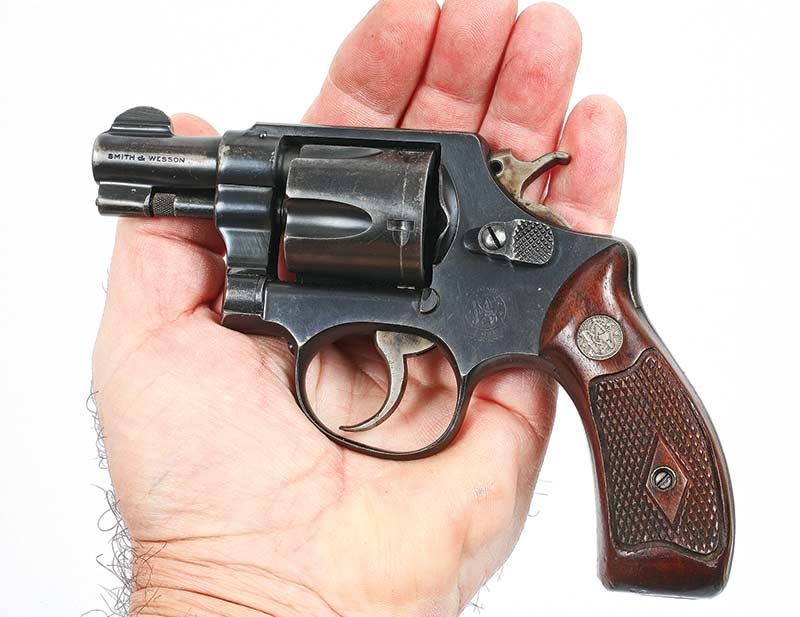
The Terrier
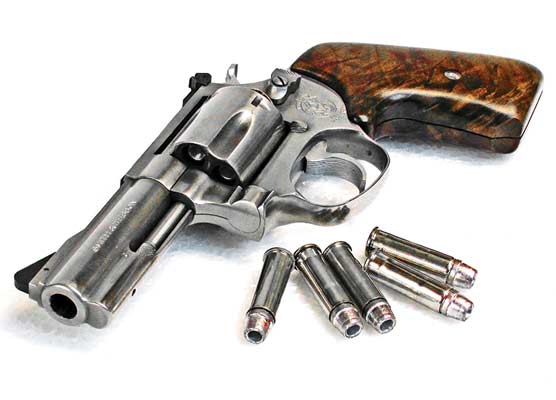
The gun in question here is a bucket list one for me. I’ve searched many years for a nice, smooth and shootable Terrier in .38 S&W that didn’t break the bank. This one, vintage 1948, was a bit over $600, but some go well over $1,000 or more for minty ones. It’s tough to nail it down, but you might consider it a transition from the old school I-Frames to the later J-Frames. Mine weighs right at 17 oz., with a 2″ barrel and round butt. If you notice it has a shorter cylinder than a Model 36 J-Frame in .38 Special and is much too short to ever chamber a .38 Special cartridge. Indeed, a .38 Special won’t even fit in the cylinder window! It’s not just a Model 36 with a short cylinder installed.
By 1950, the J-Frame Model 36 production was ramping up with a larger cylinder window to accommodate the longer .38 Special cylinder. Note the differences between the Terrier and the Model 36 in the picture. Note also the rounded half-moon front sight on the Terrier, while the Model 36 in the photo has the ramped front. Mine was made in 1955, so it is a very early gun.
The Terrier also has the famous “Five Screw” construction, with four screws securing the side plate and a single screw in front of the trigger guard holding the plunger and spring for the cylinder bolt. That final screw was deleted soon after the post war models came out and eventually the screw at the top of the side plate was deleted too, leaving us with today’s “three-screw” models.

The setup Roy used to test the Terrier at 15 yards. Once dialed in and settled, a Ransom Rest is a sure-fire way to test intrinsic accuracy from a handgun.


A .38 Special 158-grain RNFP on left, a 146-grain Remington
.38 S&W next, followed by a standard 148-grain target wadcutter
in .38 Special. The Special cartridge won’t fit in the Terrier’s cylinder window.
The Real Secret
I tend to shoot even the rare guns I might encounter, and my Terrier is no exception. It checked out 100% fine, so I grabbed some 50+ year old classic 146-grain RNL .38 S&W ammo I had, and after a bit of test firing, found this little gun can really shoot. Also, the ammo delivered right at 600 fps over my chronograph, which is a bit higher than I thought it would be. Intrigued by the accuracy, I dug out my Ransom Rest, bolted in the J-Frame round butt inserts and clamped the Terrier in since it fit well enough.
Believe it or not, at 15 yards, the Tiny Terror put 10 rounds into that tidy 1″ group. Note how it’s well-rounded, too, meaning the Ransom Rest was dialed in neatly and the gun shoots very consistently, with no stringing. Much to my surprise, that 50-year-old Remington ammo (price on the box was $4.95!) shot amazingly well. This proves, yet again, how small-frame revolvers shoot just fine, and if people complain about their accuracy, it’s the shooter, not the gun.
Some don’t realize the .38 S&W has a bore size of 0.360″ as opposed to the 0.357″ of the .38 Special. So, .38 bullets tend to sort of slide down the bore of a .38 S&W, and accuracy almost always suffers if you use .357 bullets to reload for the .38 S&W. I have ordered some properly sized 148-grain Wadcutter bullets in .360 to reload, and will fill you in on how they work out later.
It’s never too late to start your own adventure with these little guns. From late 1800s, .32 break-tops to modern cutting-edge designs, the pocket-sized wheelgun still holds its own and remains as delightful as, well, messing around in boats.