The Model 1877 Double Action
Colt’s First Double-Action Revolver
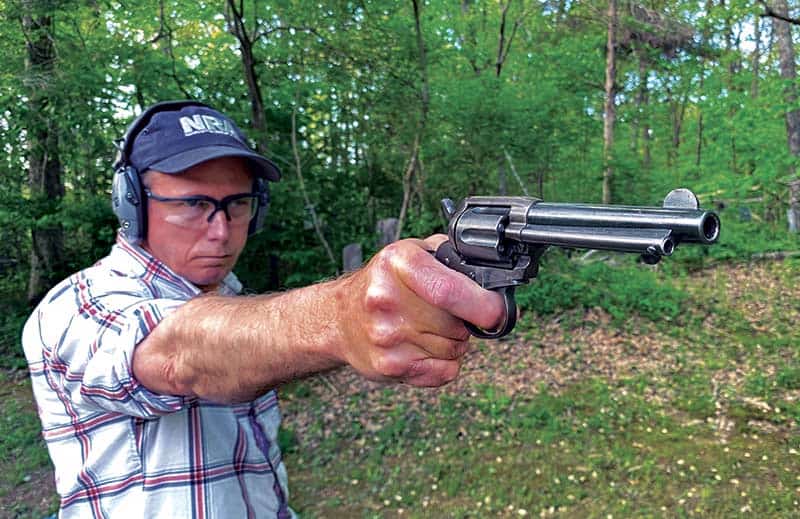
Colt nailed the ergonomics of the modern double-action with the Model 1877 DA.
In 1877, Colt’s Patent Firearms introduced its first double-action revolver. Listed in the catalog as Colt’s Double Action Central Fire, Six Shot Revolver, collectors know it today as the Model 1877 DA. Thanks to the marketing flair of Benjamin Kittredge & Company of Cincinnati, Ohio, one of Colt’s largest distributors, it was called in its day the Thunderer when chambered in Colt .41 Long, the Lightning in Colt .38 Long, and the Rainmaker in .32 Long. Because only a couple hundred were made in .32, the Rainmaker nickname is largely forgotten, but Thunderer and Lightning have become part of the lore of the Old West.
Records show 166,849 were made from 1877 to 1909, and for the last 20 years of production, it competed with Colt’s more refined, swing-out cylinder, double-action revolver designs. As a frame of reference, during the 32 years the Model 1877 DA was in production, Colt made 275,000 Model 1873 Single Action Army (SSA) pistols. Without a doubt, the Model 1877 DA was a successful product for Colt, though a reputation clings to it for having a fragile action prone to spring breakage that could render its double-action function inoperative until repaired. In keeping with the Apparatus Insignis tradition, I’ll explore some reasons it may have deserved this reputation, and some evidence that it didn’t.
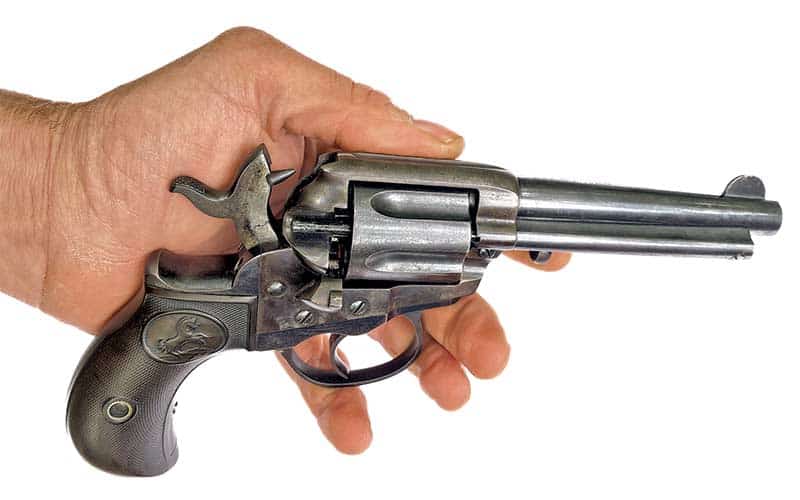
The pistols were offered with and without the familiar
barrel-mounted ejection rod. Barrels under 4.5" normally
had no shroud and used the cylinder pin to push out spent casings.
Serious Users
Quite a few serious shootists used the 1877 DA Colts. The most well-known were John Wesley Hardin, Billy the Kid, “Doc” Holliday and Pat Garrett, the first two relying on the little double-action six-shooter as their preferred and primary weapon at times. All across the country and notably in urban areas where the need for concealability favored smaller guns, it was used by professional law enforcement officers, expressmen, and others in lines of work where they had good reason to expect to use deadly force.
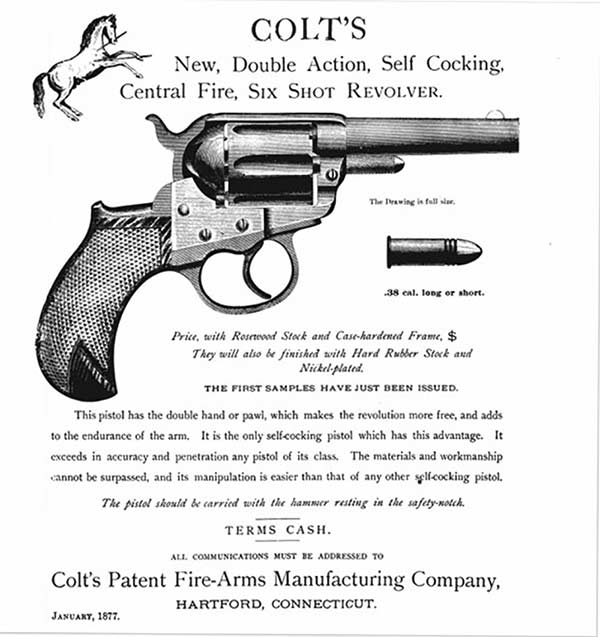
Below: Colt’s first advertising for the Model 1877 DA showing
it with the one-piece, checkered, Brazilian rosewood grip
common on early guns and lacking a barrel-mounted ejector.

Here you can see the cylinder stop protruding from the recoil
shield into a locking cut at the back of the cylinder. In addition
to needing precise fitting, it lacks the strong spring pressure of
the conventional (up-from-the-bottom) design to assist it into
lock-up, a weakness inherent in the design.
Were They Reliable?
This makes me suspect the lingering tales about the Model 1877 DA being prone to breakage need to be regarded with skepticism. If these arms were so problematic, why were they used by so many people over so long a period of time? I believe the genuine complaints about the Model 1877 DA’s reliability have become exaggerated as they’ve aged. All guns break from time to time. Given that the newest of the Model 1877 DA revolvers are 116 years old, why wouldn’t they be broken? The question is: “Did they break frequently way back when in the hands of their original owners?”
The odds are they did, but apparently not so frequently to dissuade people from buying them. Having tinkered around inside a few, I can see why gunsmiths of the late 19th century, accustomed to the simplicity of the single-action, or gunsmiths from more recent times accustomed to working on modern double-action revolvers, could find the Model 1877 DA vexing. Compared to the single actions of the day, and even period English double-actions, the Model 1877 DA is complex and by no means a masterpiece of practical engineering. With two-piece grips, the Model 1877 DA had a total of 54 parts, including five flat springs of varying delicacy and sometimes wholly unfamiliar geometry. In comparison, a black powder single-action 1873 Colt with two-piece grips had only 41 parts and three simple and robust flat springs that were quite easy to replace, and even make if necessary. More springs mean more to break, so the Model 1877 DA is obviously at a disadvantage in that respect.
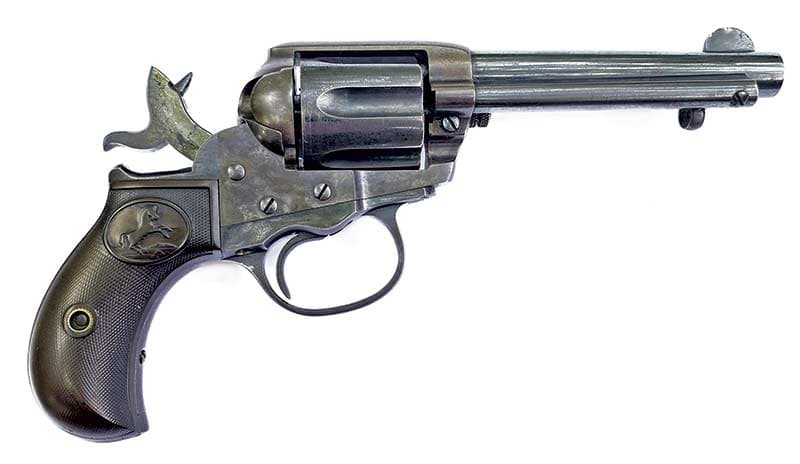
The Model 1877 DA had four hammer positions: full cock for SA fire,
loading position, safe carry position and fully down with the firing pin
protruding through the recoil shield. The pistol could be instantly
fired in DA in any of the latter three hammer positions.
Gunsmith’s Favorite?
A gunsmith worthy of the name should possess an affinity for the mechanical, and such a man with a supply of replacement springs on hand wouldn’t find any great challenge in doing the necessary fitting to replace a broken one. To this man, the Model 1877 DA would be “The Gunsmith’s Favorite.”
In my research, the trigger return spring is the most common spring failure encountered today. It’s also the easiest to repair and a reasonable DIY project for someone with a modest amount of mechanical sensibility. That being said, I’d prefer not to make that spring; and neither did Old West gunsmiths because there was more that could go wrong than right in trying to fashion an unfamiliar spring. The metallurgy and heat-treating techniques of the time could make consistent spring quality control a real challenge, at least until the best practices were discovered by experimentation. I’d expect a certain number of failed springs early on in the production process as the factory trained up to build the new gun. People remember when things break more than they remember when they work perfectly … and so a bad reputation can be made.

The front of the revolver looks like a scaled-down Model
1873 SAA, including the tiny notch and thin blade front sight.
In DA shooting, conventional sighting is impossible.
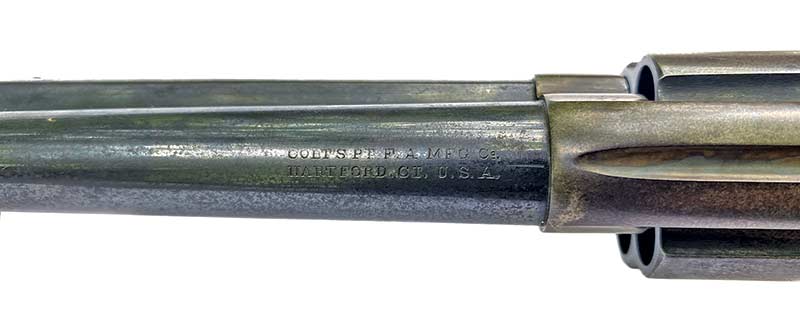
The Colt name was a guarantee of top-quality materials and construction.
Naturally, the Colt 1877 DA revolvers cost more than the imports from
Britain and Belgium they were initially competing with.
Lockwork Design
The other major criticism of the Model 1877 DA is the basic strength of the lockwork design. Colt Factory Superintendent William Mason designed the 1877 DA. It would be hard to find a man with better credentials. He was the co-designer of the Model 1873 SAA and, by all accounts, a man of exceptional talent. On the Model 1877 DA, Mason used the cylinder lockup he previously designed for the little pocket metallic cartridge Colt New Line revolvers.
Rather than having the locking bolt engaging cuts around the outside circumference of the cylinder in the conventional way, the New Lines had narrow locking notches cut between the chambers in the rear face of the cylinder engaged by a thin cylinder stop that protruded through the frame’s recoil shield. He revisited this idea in the larger Model 1877 DA and again in the swing-out cylinder Model 1889 New Navy Revolver. Though it obviously worked, it could not be the equal of the conventional cylinder lock-up used on Colt’s single actions, which were physically larger, mechanically stronger and more durable.
I wouldn’t be too critical of Mason for this. He got the ergonomics of the Model 1877 DA perfect, and it’s the equal of a modern double-action revolver in that respect. The physical layout of a double-action revolver, with the trigger under the middle of the cylinder instead of the rear as in Colt’s single actions, didn’t leave much room for the conventional cylinder stop, and the one Mason developed for the New Line was an off-the-shelf solution. Also, coming to the double-action game late, Colt put Mason in the position of having to work around existing, mostly British, patents.

One of the reasons the Model 1877 DA got traction in the
American market was it offered a lot of firepower in a considerably
more compact and lightweight package than the Model 1873 SAA.

From this angle, you can compare the grip size of the
Model 1873 SAA (left) and the Model 1877 DA (right).
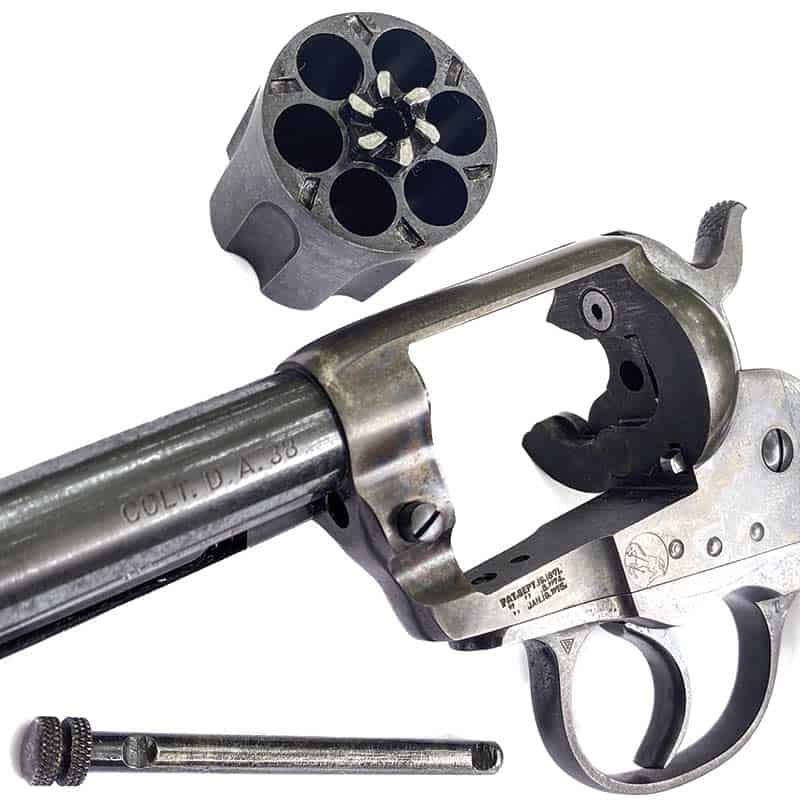
The new layout of the Model 1877 left little room for a conventional
cylinder stop, so Mason used the rear locking cylinder stop he
designed for the Colt New Line series of SA pocket pistols.
Durability: DA Vs. SA
The Colt single actions’ well-earned reputation for simplicity and reliability made them a tough act to follow. Just by virtue of having more action springs and smaller, less rugged parts, I would expect the Model 1877 DA to be more susceptible to breakage than Colt’s single actions over the long haul. When and how often the guns’ inherent design weaknesses manifested themselves during their normal use lifespan, I can’t say with certainty. Their popularity suggests they worked well enough, long enough.
Today, over a century later, it’s common to find them out of time, One weird timing failure with the 1877 DA that I’ve personally observed was a lag in the retraction of the cylinder lock from its slot in the rear face of the cylinder that caused its exposed tip to catch on the rim of the cartridge case and prevent it from rotating!
The Colt 1877 DA wasn’t the first double-action revolver in America, but it was the first widely produced true double-action revolver in America. Other American companies followed Colt’s lead in the 1880s, with the biggest-selling double actions being those .38 caliber and below, with the low-quality end of the market responsible for the majority of production. When it came to big bore revolvers, Americans clung to the single-action for an unusually long time for a people building up an industrialized, technologically sophisticated society. I suspect this had a lot to do with the folklore of the Old West, which Colt, the man and the company, continuously cultivated to their marketing advantage.