THE SIXGUNS OF
AMERICAN FRONTIER FIREARMS

** American Frontier Firearms closed their doors in late July 2002 — This post is for historical reference. **
Colt and Smith & Wesson started as handgun manufacturers on two entirely different paths in the mid-1800s. Colt dates back to 1836 and the first practical revolver, the Paterson. The five-shot Paterson with its folding trigger was a fragile design but a grand improvement in firepower over the single-shot pistols of the frontiersmen. Starting with the Paterson and moving through the Walker, 1851 Navy and 1860 Army, all of Colt’s sixguns were cap and ball, or percussion, revolvers.
Smith & Wesson got started about the same time that Colt was bringing out the 1851 Navy and 1860 Army, but on a much different plane. Horace Smith and Daniel Wesson never did manufacture a cap and ball revolver, but rather brought forth the first cartridge-firing sixgun, actually a seven-shooter, in the first rimfire cartridge, the lowly little .22.
Smith’s Model No. 1 was a tip-up design, with the hinge at the top rear of the frame. While Colt’s big sixguns were found in flap holsters on the hips of the troops, Smith & Wesson’s little gun was more often hidden inside shirt or tunic.

(Left to right) 1860 Cartridge Conversion, 1851 Cartridge Conversion
1871 Open Top, SAA.
A Top-Notch Replica
Both companies now had their niche — Colt made large-frame revolvers while Smith produced their little guns in .22 and .32. However, unbeknownst to Colt, S&W was working on a large bore, cartridge-firing sixgun that would become the Model #3. Smith held the Rollin White patent that allowed revolver cylinders to be bored-through to accept fixed cartridges. Their .44 Model No. 3 was interrupted by the Civil War and was subsequently introduced in 1869.
Colt was caught flat-footed with a suddenly obsolete design and facing a patent that would not run out for several years. Colt saw the writing on the wall and brought forth the “cartridge conversions” of their percussion revolvers, a model called the Open-Top and, finally, the legendary Single Action Army.
Now, to the point of my history lesson — all of these guns were available in replica form from American Frontier Firearms. These sixguns were made of American parts and totally assembled and finished in this country.
Frontier Firearms’ “cartridge conversion” models carried a retail price tag of about $700 in 2001.

Taffin shot the groups here with two hands while standing.
Buttery Smooth Feel
At the time, it was virtually impossible to find an American-made sixgun from any of the old line companies that had a deep, high-polish, blue finish. Remember the Smith & Wesson Bright Blue? The Colt Royal Blue? Or the original Ruger Super Blackhawks? All had beautiful bluing. That’s the quality of finish found on all Frontier sixguns.
Special care was also paid to the fitting. The actions were smooth. As the hammer was cocked, one was almost transported back to the 1880s when all sixguns were handfitted and polished inside for a buttery smooth feel.
I love to hand a properly tuned and fitted single-action to someone who has an out-of-the-box, rough-as-a-cob single-action and watch the reaction as they cock a tuned gun. It’s a look of pure joy.
Grips on the 1851 were well-fitted, one piece walnut that could benefit with an oil finish being added. The shape of the grips were the same as found on a Colt SAA and the entire sixgun felt and balanced much like my favorite 7 1⁄2″ Colt.
The .44 had a silver trigger guard, blue backstrap, barrel and cylinder, with a case colored frame and hammer. The blue was deep and dark, the case colors were breath-taking on both hammer and frame, and the one-piece walnut grips, while not a perfect fit, were very close.
As with the 1851 Navy, the action was smooth and rivaled those found on sixguns worked over by the top single action ’smiths.

Taffin shot these groups with one hands while standing.
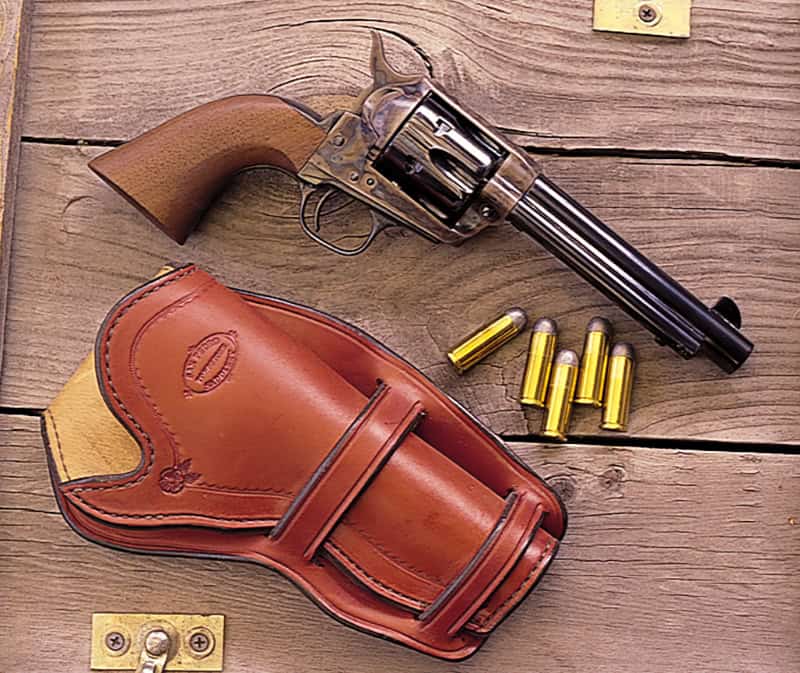
Leather by San Pedro for AFF's .45 Colt.
Well Fitted And Timed
Both the 1860 Richards and the Open-Top shot to the same point-of-aim, which is on for windage and about 2″ high when shot standing two-handed or one-handed, duelist style. That means they make a formidable pair for cowboy shooting.
The Open-Top, chambered in .44 Colt, was beautifully finished, but instead of case coloring, the entire sixgun was a deep blue all over. Only the hammer was case colored. Grips were one-piece walnut of the same shape and size as an SAA. At the fear of sounding redundant, this sixgun was also very well fitted and timed and very smooth in its operation.
In 2000 American Frontier Firearms was just getting into their Single Action Army production. They had their first one, a 7 1⁄2″ .357 Magnum, at the 2000 SHOT Show and my test gun was the first in .45 Colt and beard the serial number of 003.
That was a beautifully finished sixgun with a deep blue and eye-catching case colors on frame and hammer, just like on the original Colt of 1873. It was as attractive a single action as one is likely to find at any time from any manufacturer. The action was very smooth and the cylinder lock-up was tight with almost no movement. Grips were properly shaped, smooth, one-piece walnut and felt very good in my hand.
The only negative on this sixgun was that the backstrap was not radiused quite right where it bolts to the frame on both sides of the hammer.
Shooting all of these sixguns was pure pleasure. The .45 Colt shot just slightly to the right and low, so it can easily be filed in to hit point-of-aim.
Two problems surfaced with the .44 Colt sixguns used in testing. As mentioned, both guns shot about 2″ high.
A second minor problem consisted of the screw that holds the loading gate in place on these models. This screw enters from the front of the base of the loading gate and when it backs out, the rims of the cartridge cases hit it and the cylinder rotates with difficulty or not at all. Loctite took care of it.
Get more revolver stories every week!
By submitting this form, you are consenting to receive marketing emails from: . You can revoke your consent to receive emails at any time by using the SafeUnsubscribe® link, found at the bottom of every email. Emails are serviced by Constant Contact