Wrangler Vs. Super Single Six
Does 50 years make a difference?
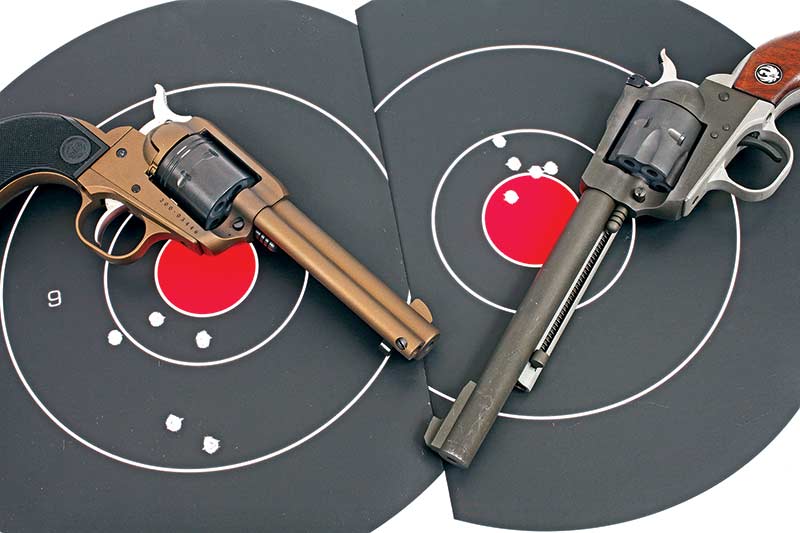
At 25 yds. the old Super Single Six (right) slammed into 1.25" while the Wrangler
did a respectable 3". Ammo was CCI Standard Velocity .22.
In about 1969 I was 15 “going on 16” as we used to say. I had a hopeless case of the “gun crazies” and had been suffering from the syndrome since I was about five. Old family photos and 8mm movies back then show me at Christmas loaded down with shiny “chrome” six-shooters, rolls of caps, cowboy hats, plastic lever-actions and all the accessories.
I was, in short, a typical American boy of the period — at the risk of being called sexist today. Sorry snowflakes, but that’s how it was then.
By the time 1969 found me in San Diego I had about worn out a Ruger Super Single Six on display at the gun counter at the Navy Exchange at the 32nd St. Naval Base. “Hey kid,” the counter guy said, “I should start to charge you rent to look at it.” I was a certified Navy brat — my dad was a Master Chief — so we were always at the Exchange. Boy, those were the good old days for sure.
As my birthday neared I gathered yard work and chore savings and came up with about $45. The gun listed at $66 and alas, there was no light on the horizon. But, as moms tend to do, she magically made up the difference the next time we were on-base and dutifully signed for the Ruger. “You’ll be careful, right,” she said looking at me seriously.
I double, triple, pinky-swore I would. The five-day wait took 30 days — at least.
Time passed. Much to my delight, I found the Ruger Super Single Six — adjustable sights and spare .22 Magnum cylinder included — fit a holster I had found in a junk store perfectly. I was in business then, with a “real” high-quality sixgun. Over the years I’ve definitely shot tens of thousands of rounds through it, paying 39 cents (on sale) for Mohawk .22 at the local Whitefront or Fedmart store. The gun belt had loops to hold .22 cartridges and lord, I felt like a real gunfighter when I wore it.
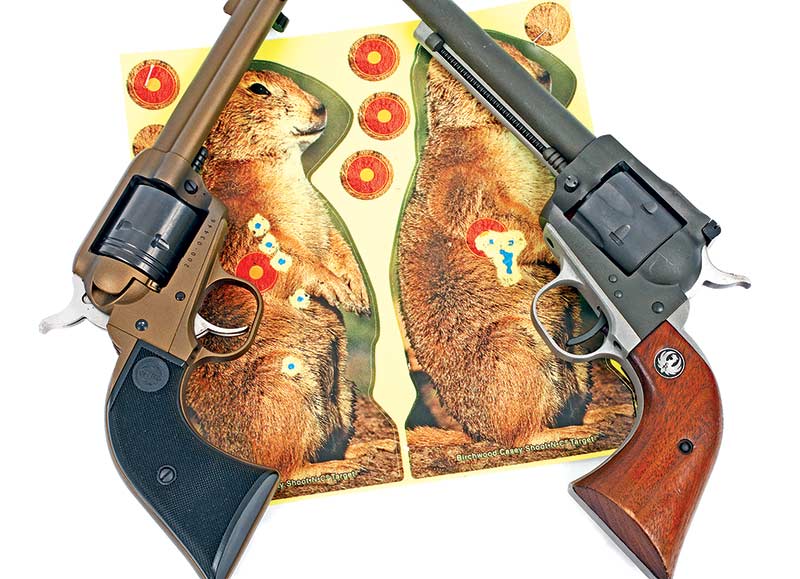
At 15 yds. the Wrangler (left) dropped them into 2 5/8" while the sister
Super Single Six chimed in with 0.75", both using CCI Mini-Mag ammo.
Hunting And Shooting
Once I got my driver’s license my brother, who was about 11 at the time, and I used to go to the high desert east of San Diego. We took the Ruger, a couple of .22 rifles we had — including my “best, first gun,” a Remington Model 514 single shot — and usually six or eight boxes of Mohawk ammo. The jackrabbit population grew to fear us, and generations of Oreo cookies, Necco Wafers and cans gave their lives as targets.
It turned us both into keen-eyed sixgunners and we learned if you took your time that 6″-barreled Ruger could pretty much hit anything out to about 100 yards. I’m guessing there are jackrabbit family stories passed down even today of how “Uncle Hoppy was sitting and suddenly got hit with a .22 from ‘way far away’ out there!”
That was likely us.
The Ruger has always enjoyed a central role in my shooting during the past 50 years. It’s helped to teach countless people how to shoot, became blue-worn, and was even scoped with an old Bushnell Phantom scope for a while. I rarely shot .22 Magnums in it as they both cost a lot and made a ruckus with muzzle blast. They didn’t seem as accurate either, and I later learned that was indeed the case. After a long-term loan to a friend I got the Ruger back with a good bit of rust on it. I had learned to Parkerize then, so I bead-blasted it and Parkerized the steel bits, leaving the aluminum raw. I actually think it looks good that way.
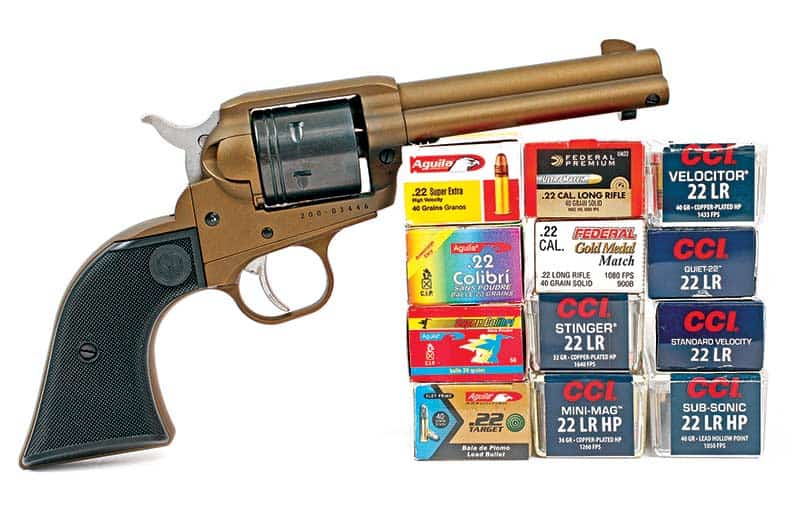
About a dozen loads were fired in an informal test. Velocity was a bit higher in the longer barrel
— up to about 100 fps, depending on the load — but wouldn’t matter in the real world.
50 Years Goes By
Which brings us neatly to the new Wrangler. When I first saw it the matte finish reminded me of my old gun, and at that $250 price I knew I had to have one. Interestingly enough, it’s only the second Ruger “Single Six” style .22 I’ve ever had, as my original always seemed to take care of the jobs at-hand. I was curious to see — did 50 years make a difference in the classic design?
My original has a silky smooth action from use and those four distinctive “clicks” when you cock it. You need to go to “half-cock” to load and unload it. The Wrangler has the new action, so you merely open the gate and the cylinder turns freely either way. Handy to get the ejector rod aligned and to load it.
The action on the Wrangler was rough and much harder to cock. Over the past couple of months it’s smoothed up some but still takes a lot more effort to cock the hammer. It’s got a hammer-forged steel barrel, Cerakote finish (black, silver and my sort of bronze color), cast aluminum frame, steel unfluted cylinder, zinc alloy grip frame and excellent feeling plastic grips.
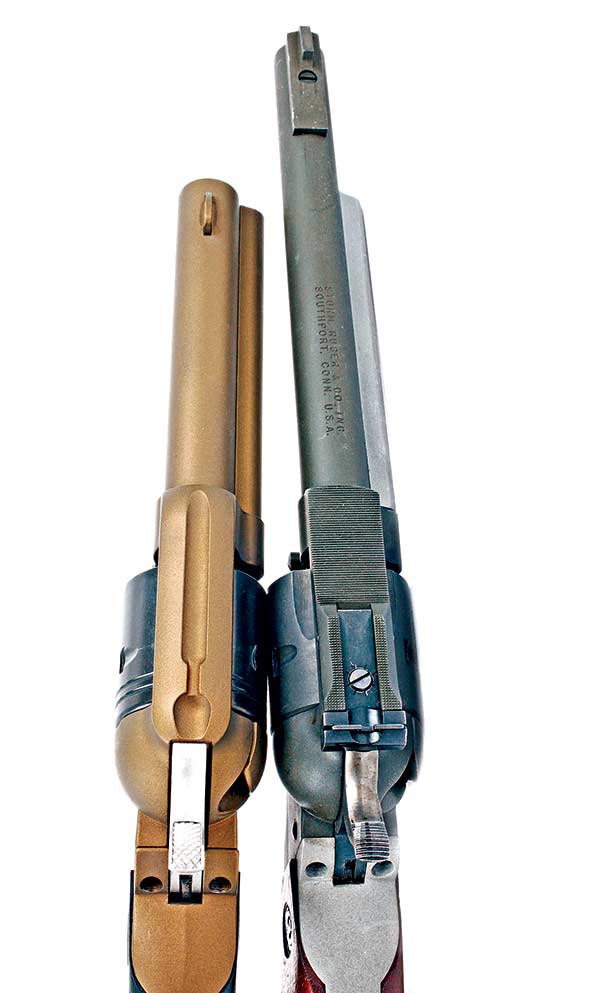
The longer barrel, adjustable sights and smoother action gave the Super Single Six
(right) the edge. Roy says both were great fun to shoot though!
Shooting Some
John Taffin put three Wranglers through his testing and it seems he had better accuracy than I did with my gun. He shot at 20 yards while I shot at 25 and 15 but I’m thinking his talented eye and trigger finger simply made the difference. I’ll keep testing mine to see if things settle in, and report back.
I put bullseye targets at 25 and small critter targets at 15. I also chronographed about a dozen different .22 loads through both guns. Velocity differences between the 6″ and 45/8″ barrels averaged between “no difference” (low velocity loads) to maybe 100 fps faster with hotter loads in the longer barrel. The no-powder Aguila Colibri 20-gr. loads (great fun, by the way), were actually slower (352 fps) from the longer barrel vs. 386 fps out of the Wrangler. I’ve seen this before with this load. The bore friction slows it down I guess.
“Most accurate” was CCI’s Standard Velocity (about 950 fps in both guns), delivering a solid 1.25″ in the Super Single Six at 25, and a 3″ group in the Wrangler. On the critter targets at 15 yards, good old CCI Mini-Mag HP ammo planted them into 0.75″ for the Super (1,175 fps) and 25/8″ and 1,072 fps (with a flyer) for the Wrangler. Without the flyer it’d be about 1.75″.
The Wrangler’s heavier trigger and hard-to-see fixed sights definitely hindered my 65-year-old eyes. Plus, it seems to hit about 4″ to 5″ low at 25 yards. At the varmint targets at 15 I was aiming at the tip of the critter’s head to hit the bull. But I’ll likely file on that front sight to raise the POI to match up with the CCI Mini-Mag load and call it good-to-go. Windage was close enough for government work.
The silky action, smooth trigger, longer sight radius and crisp adjustable sights of the old gun really showed their mettle. But having said that, I see a use for both. The “target” features of the Super Single Six (and similar modern models) makes it very versatile for hunting, plinking, teaching, even serious target shooting.
The Wrangler is just plain fun, and with a bit of tweaking the zero — and smoothing the action a bit — can almost hold its own. It’d be a great trail gun, trap-line tool, boat or truck gun, and even a young person’s “first” handgun. In the real world, they seem to go for around $200 or a bit more, so if you get your kid one, you could get a different color for you and the third color for your wife, or — I’ll be modern here — your husband! It’s all great fun, so you should dig in too.
For more info: www.ruger.com.
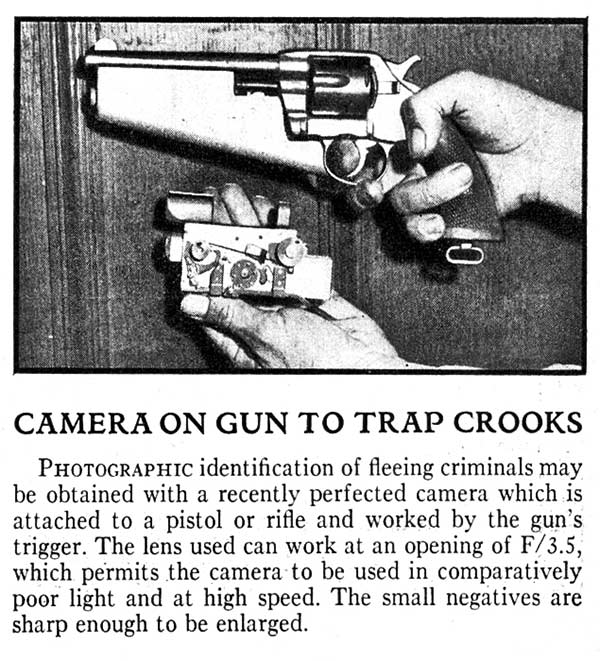
Gun Camera?
Who says ideas are new? Check out this newspaper piece from the 1930s about a new “Camera on gun to trap crooks!” The tiny camera attached to the underside of, in this case, a Colt revolver, was activated when the trigger was pulled. Sound familiar? It apparently never caught on due to the technology then, but I’m betting we had the same issues back then as we do now. Nothing is new.